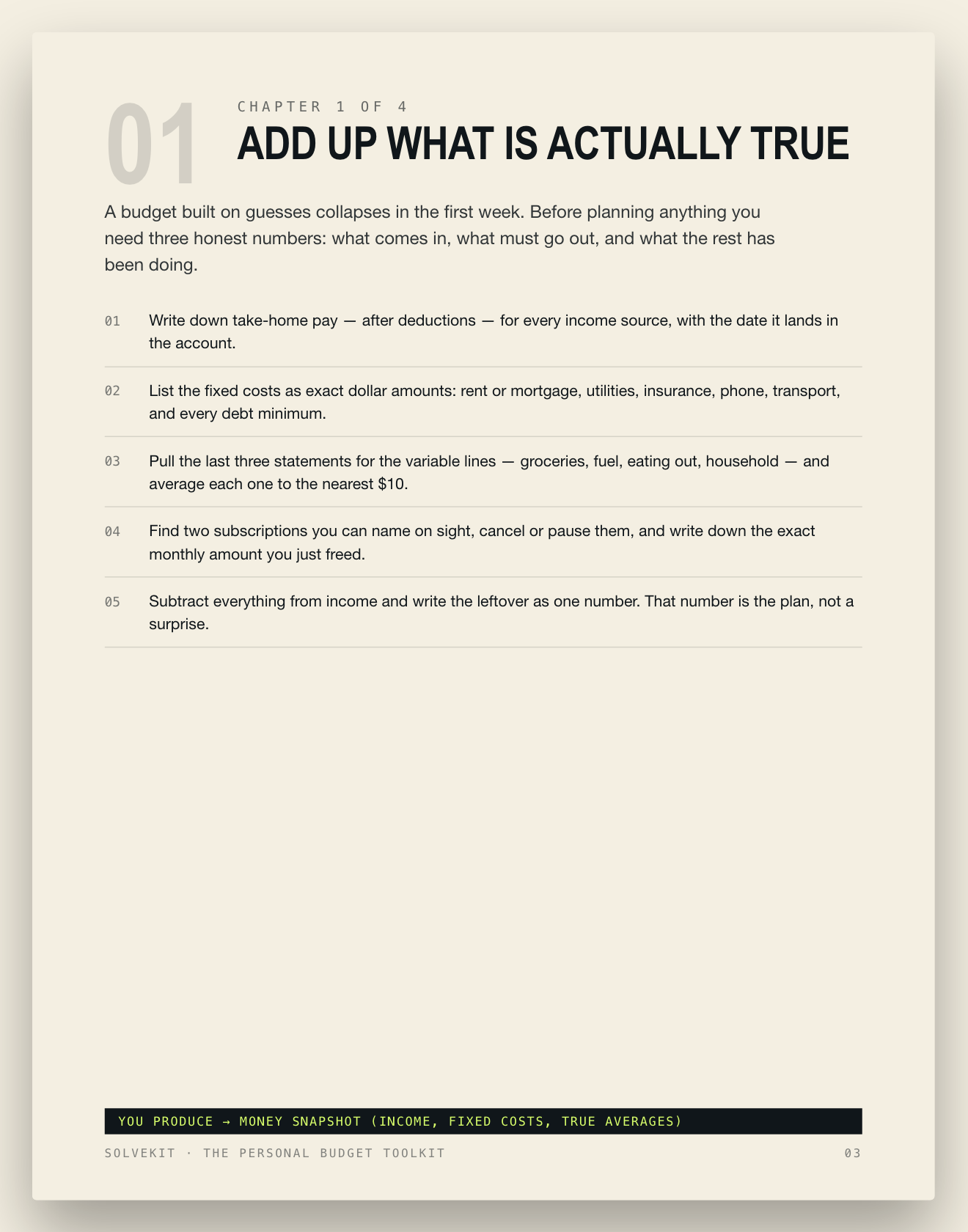
Add up what is actually true
A budget built on guesses collapses in the first week. Before planning anything you need three honest numbers: what comes in, what must go out, and what the rest has been doing.
answers “how to budget your paycheck”
A paycheck-to-paycheck system: one budget sheet, one bill calendar and one spending tracker you fill in and check every Sunday — three spreadsheets, two printable pages.
Give every dollar of the paycheck a job before the month starts, and see where it went by the end.
No invented pain points — these are the sentences the bundle was written against, taken from how people phrase the problem. Built for beginners.
The paycheck arrives, the bills get paid in a panic, and week three has nothing left to show for it.
You know the rent by heart but not what groceries, fuel and subscriptions actually cost you each month.
The card balance gets paid 'this month' and is higher than it was three months ago.
Every budget you started was a spreadsheet you stopped opening by the twelfth.
An annual renewal or a late fee hits and there is no line anywhere in your plan for it.
You know what is due on which day, the grocery number you are working with this week, and which line to cut when the month runs long — the bills get paid without a scramble at the end.
Reddit is not included: its anonymous API returns 403 from this machine. These are other people's public questions — proof the problem is asked a lot, not proof this product works. Read them yourself.
Each title links to the original thread in a new tab. The titles are quoted exactly, so if a site is unreachable from your network you can still find the thread by searching it.
Every chapter ends in something you keep and use — not a summary, an artifact.
A budget built on guesses collapses in the first week. Before planning anything you need three honest numbers: what comes in, what must go out, and what the rest has been doing.
Every dollar gets a destination before it arrives: bills first, then what you keep, then what is left to spend. A budget that does not total to income is a wish list.
The plan only helps if you can compare it to reality while the month is still running. One tracker, updated the same day, beats a perfect file you never open.
The last ten minutes decide whether this repeats. Fix what slipped, protect what worked, and the next budget starts from a real month instead of a hope.
The Personal Budget Toolkit Workbook — print it, fill it in, keep it next to the plan. 18 checklist items included.
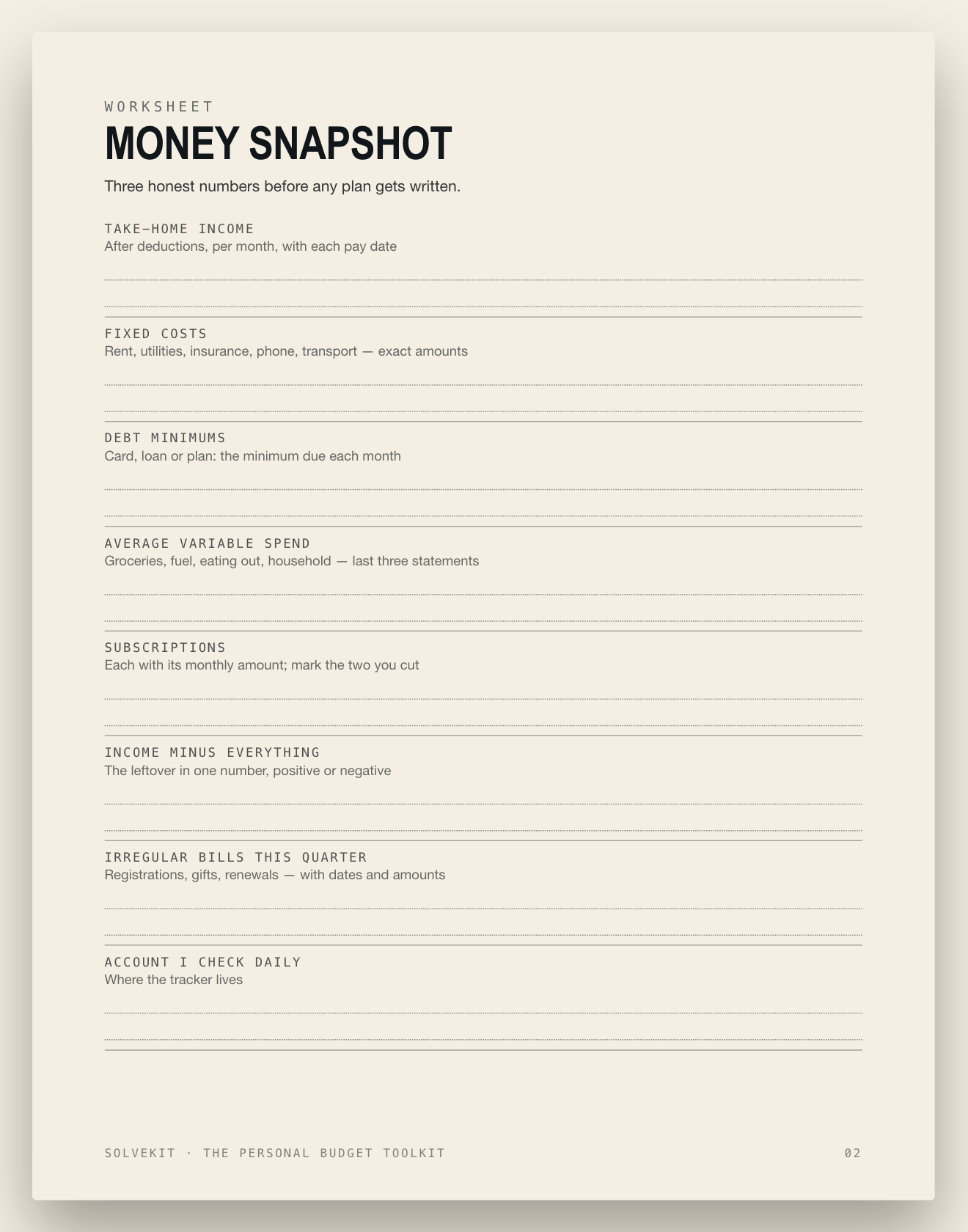
Three honest numbers before any plan gets written.
Fill it in this order and the total has to equal your income.
Every due date on one page so nothing arrives as a surprise.
Plan against reality, line by line — the numbers only, not the story.
Each one appears in the guide with the fix beside it.
Remembered numbers are usually the flattering ones, so week three always looks like a betrayal.
→ Average the last three statements for every variable line and budget those figures.
A vague 'save more' loses every argument against a small purchase you want today.
→ One amount, one account, transferred the day after payday.
By then the month is already spent and the only fix left is a panic cut that does not last.
→ A ten-minute Sunday check that totals each category and writes what is left.
Registrations, gifts and annual renewals arrive as emergencies every single year.
→ A buffer line in the budget and every due date on the bill calendar.
8 files, no login, no subscription, no upsell inside the folder.
First lines of spending-tracker.csv
date,category,description,amount,method,note 05-02,groceries,weekly shop,74.20,debit, MM-DD,groceries,,,, MM-DD,transport,,,, MM-DD,utilities,,,, MM-DD,eating out,,,, MM-DD,household,,,, MM-DD,fun,,,, MM-DD,health,,,, MM-DD,other,,,,
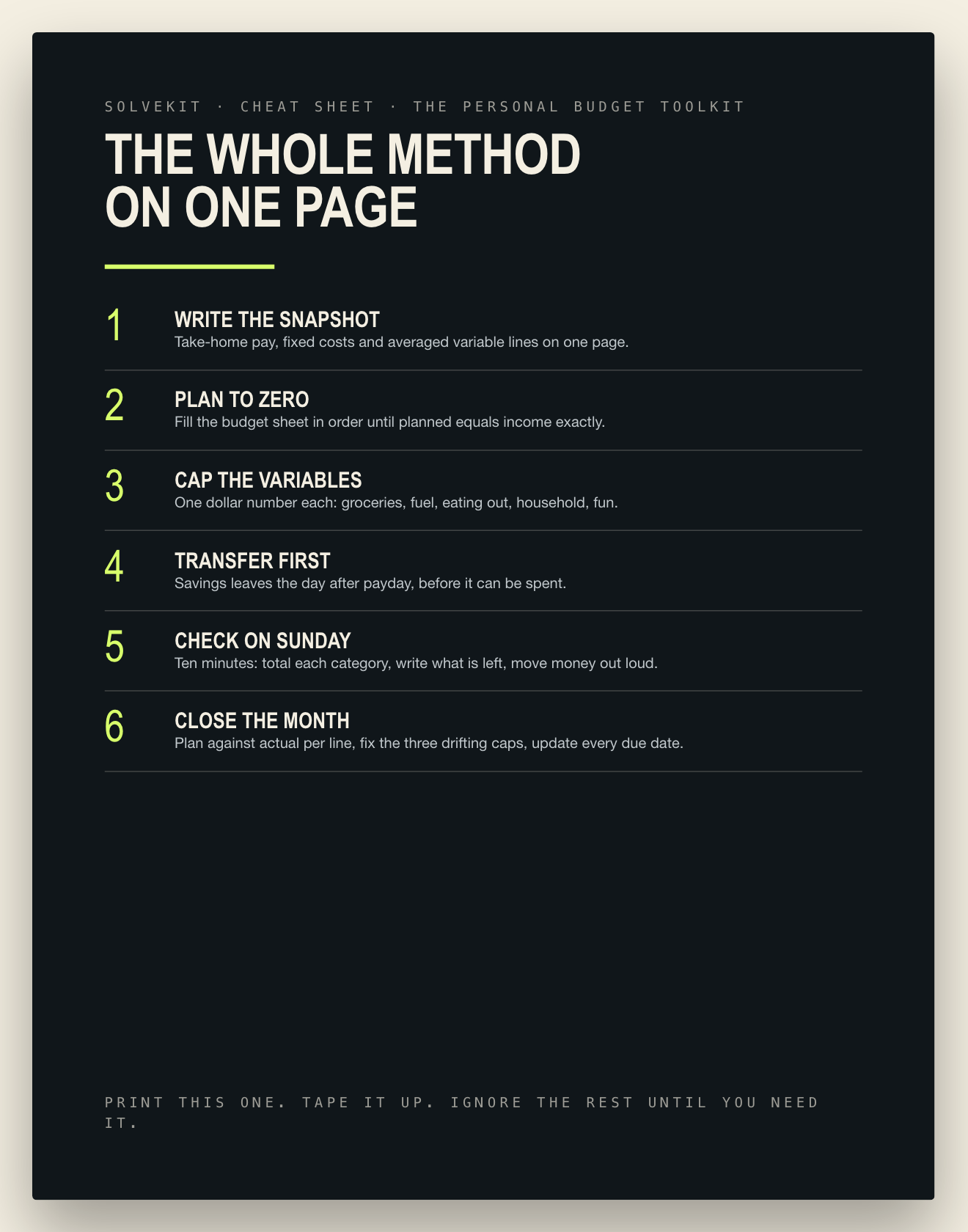
The Personal Budget Toolkit Cheat Sheet — print it for the fridge or send it to the group chat.
Take-home pay, fixed costs and averaged variable lines on one page.
Fill the budget sheet in order until planned equals income exactly.
One dollar number each: groceries, fuel, eating out, household, fun.
Savings leaves the day after payday, before it can be spent.
Ten minutes: total each category, write what is left, move money out loud.
Plan against actual per line, fix the three drifting caps, update every due date.
Real pages from the bundle, rendered at full resolution — nothing here is a mock-up of a different product.


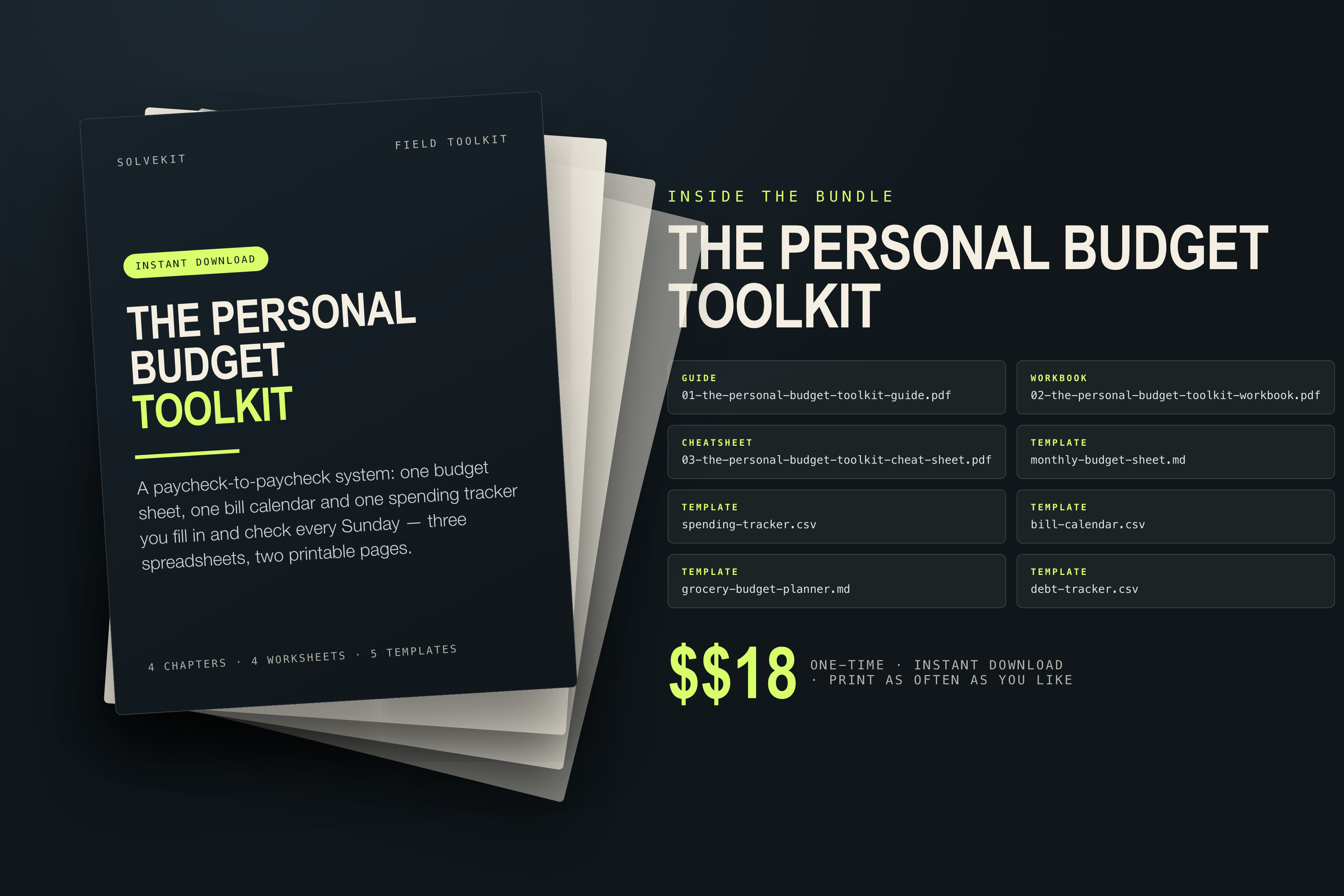
Two are spreadsheets that add themselves up; three are printable pages.
A printable guide, a fill-in workbook, a one-page cheat sheet and five templates — three spreadsheets (`.csv`) that open in Google Sheets or Excel, and two printable pages.
No. It is planning and tracking: what comes in, what goes out, what is due when. Decisions about investing, taxes, loans or which debt to attack first are yours to make with a professional.
Two things: the caps come from your last three statements instead of guesses, and the only recurring task is a ten-minute Sunday check that tells you what is left in each category.
No. Print the pages or open the spreadsheets anywhere you like. If you already use your bank's app, the tracker is still the place where the plan and the actual spending meet.
The store emails the download link as soon as payment clears. It is a set of files, not a course, so there is nothing to wait for.
Read this before you buy. It matters more than any headline above.
Instant download · one-time payment
Checkout runs on Gumroad. You get the download immediately after payment.