$20 · instant download Get the toolkit — $20

answers “how to organize closet”

The Home Organizing Toolkit

A room-by-room system: sort, decide, assign and keep — with a zone sort sheet, a labeled zone map, an inventory spreadsheet and a 15-minute reset.

Turn one messy space into a labeled system you can put back in ten minutes.

4chapters
4worksheets
5templates
8files

This is you, in 5 lines

No invented pain points — these are the sentences the bundle was written against, taken from how people phrase the problem. Built for kids.

You start on Saturday with one donate bag and end Sunday with everything back where it was.

You bought bins and organizers first, and now they hold the clutter neatly in place.

Half the things you reach for are in the other room, so the counter becomes the default shelf.

Every drawer holds a mix of things with no category, so nothing stays put for more than a week.

The space looks right for seven days, then drifts back because nobody wrote down where things go.

what changes after

You know where everything lives, the pile in the corner has a home or a box for the door, and the room goes back to reset with a fifteen-minute routine instead of a lost weekend.

  • how to organize closet

Why this keeps getting asked

Reddit is not included: its anonymous API returns 403 from this machine. These are other people's public questions — proof the problem is asked a lot, not proof this product works. Read them yourself.

3
public questions matched
109
answer points on those threads

Each title links to the original thread in a new tab. The titles are quoted exactly, so if a site is unreachable from your network you can still find the thread by searching it.

Four chapters, each ending in a page

Every chapter ends in something you keep and use — not a summary, an artifact.

01

Choose one zone and see it all

Organizing the whole house fails because it never ends. One zone, emptied and counted, teaches you the real volume you are working with before you commit to anything.

01Pick one zone — one closet, one pantry section, one drawer bank — and put it on the calendar with a start time and a stop time.
02Pull everything out onto a sheet or blanket so you see the true volume instead of the estimated volume.
03Sort as you go into four piles that stay apart: keep, relocate, donate, discard.
04Count the keep pile by category — tops, tools, snacks, cables — so container sizes follow the stuff, not the other way round.
05Write a one-line reason for each keep item: use it, need it, or want it. No reason, no home.
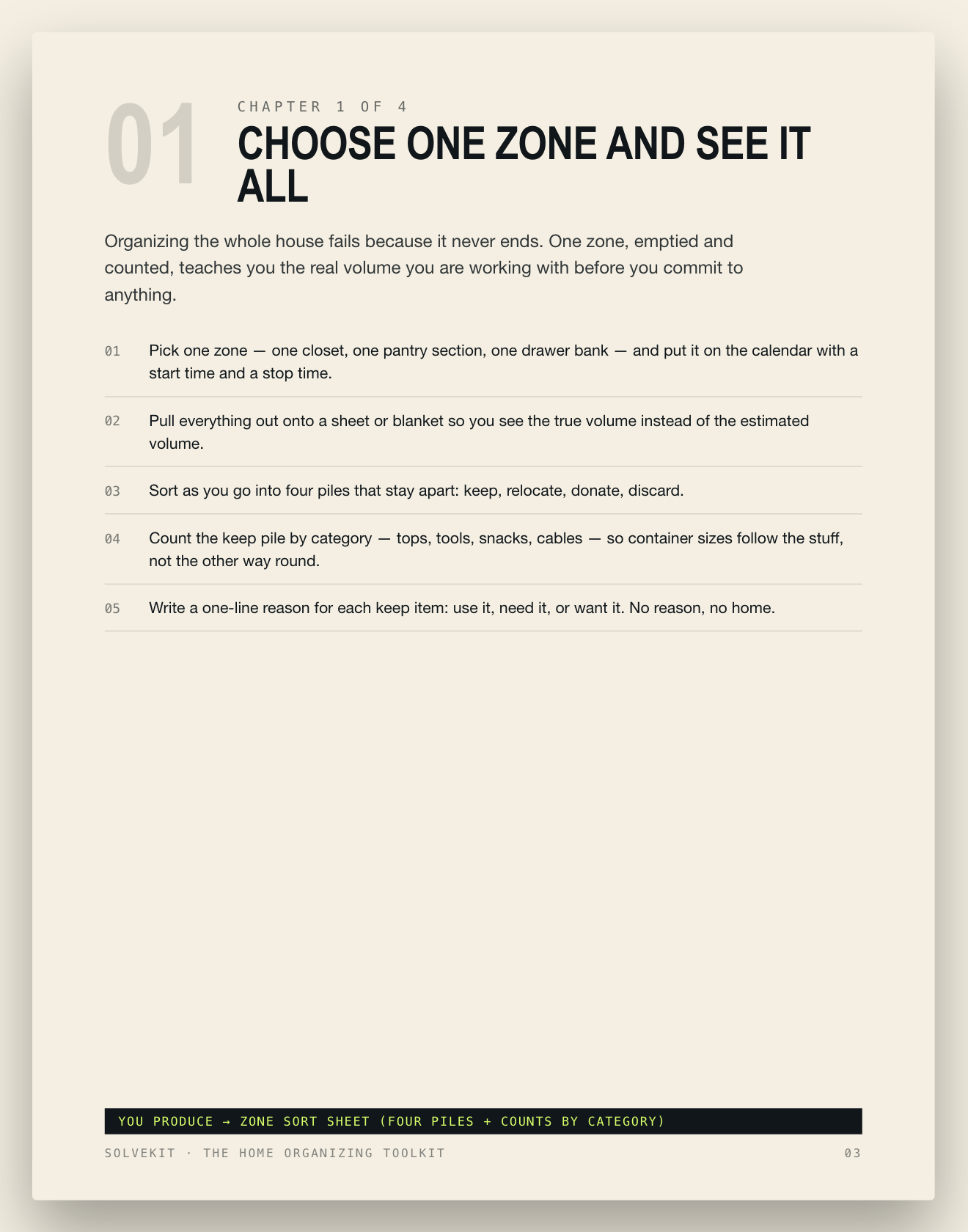
you finish with: Zone Sort Sheet (four piles + counts by category)
02

Decide the homes before you buy anything

A home is an address for each category. Set the addresses and the labels first — only then does a container have a job to do.

01Name each category in one word and merge any category holding fewer than three items into its neighbor.
02Assign every category a home in the room where it is used — socks in the bedroom, snacks in the kitchen, tape in the desk.
03Measure the shelf or drawer before shopping, and use the boxes, trays and bins you already own first.
04Write a label for every category — a printed word or a photo card — including the ones you are sure you will remember.
05Set the capacity: note how many items fit, so 'too much' becomes a number instead of a feeling.
you finish with: Zone Map + label list with capacities
03

Put it back and photograph the result

The system survives only if putting things away is easier than leaving them out. Placement, labels and one reference photo do that work.

01Place daily-use items at hand height and rarely used items above or below, so the daily row stays clear.
02Face every label outward and set the heaviest container on the bottom shelf so it stays put.
03Leave one open slot in each category — the empty space that absorbs the next thing you bring home.
04Return the relocate pile the same day: nothing from the four piles is allowed to be left on the sheet.
05Photograph the finished zone and save it as that zone's reference photo on your phone.
you finish with: Finished zone + saved reference photo
04

Keep it with a short reset

Clutter is a daily drift, not a one-time event. A fifteen-minute routine and a monthly check keep the zone from undoing itself.

01Run the 15-minute reset at the same time every day: return out-of-place items, empty the open slot, clear the surface.
02Post the one-in, one-out note on the closet or pantry door so new purchases cannot overfill the capacity you set.
03Book a 20-minute monthly check to re-read the labels, fix any category that drifted and empty the open slot.
04Log the zone on the tracker — date sorted, items donated, reset set, next check — before you start the next zone.
you finish with: Zone Tracker row + posted reset routine

The workbook

The Home Organizing Toolkit Workbook — print it, fill it in, keep it next to the plan. 18 checklist items included.

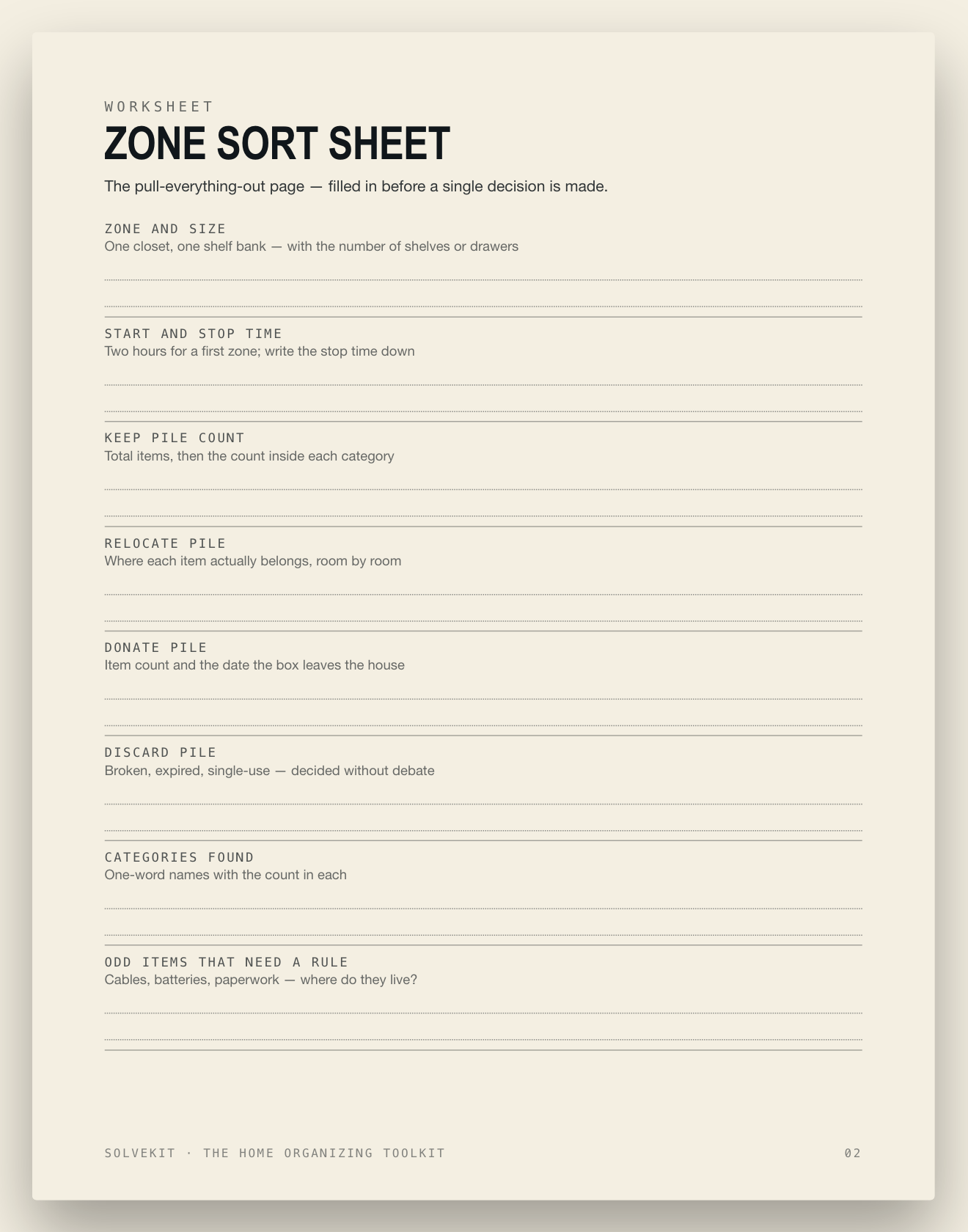
Zone Sort Sheet

The pull-everything-out page — filled in before a single decision is made.

Zone and sizeStart and stop timeKeep pile countRelocate pileDonate pileDiscard pileCategories found

Zone Map & Labels

The address of every category, with the label wording and the capacity.

Zone nameShelf or drawer layoutCategory to homeLabel wordingCapacity per categorySpace measuredContainer chosen

Reset Routine

Fifteen minutes a day and twenty a month — the whole upkeep.

Daily reset timeThe three movesItems that always driftWhere each drifter livesOne-in, one-out note locationMonthly check dateWhat the monthly check covers

Zone Tracker

One row per zone, so the second room starts after the first one is stable.

ZoneDate sortedItems keptItems donatedLabels and containers usedNext check

Mistakes the method prevents

Each one appears in the guide with the fix beside it.

Buying bins before sorting

A container freezes whatever you put in it, so the clutter gets a permanent address and a permanent cost.

→ Sort and count first; buy only for a measured shelf holding a named category.

Doing the whole house at once

Five half-finished rooms feel worse than one finished closet, and the project gets abandoned on the second day.

→ One zone per weekend, with a stop time and a reference photo at the end.

Keeping by guilt instead of use

The 'maybe someday' pile is exactly what made the space unmanageable in the first place.

→ Keep only what you can give a use, a need or a want in one written line.

No labels, no routine

Unlabeled categories dissolve within a week and everything drifts back onto the counter.

→ A label on every category, plus the 15-minute reset written into the week.

  • One zone chosen, with a start time and a stop time on the calendar
  • Sheet or blanket down and everything pulled out of the zone
  • Four piles kept apart: keep, relocate, donate, discard
  • Keep pile counted by category
  • One-line reason written for every keep item
  • Categories named in one word, small ones merged into a neighbor
  • Every category assigned a home in the room where it is used
  • Shelf or drawer measured; no container bought yet
  • Labels written or printed for every category
  • Capacity noted for each category: how many items fit
  • Heaviest container placed on the bottom shelf
  • Daily-use items at hand height, rare items above or below

Exactly what downloads

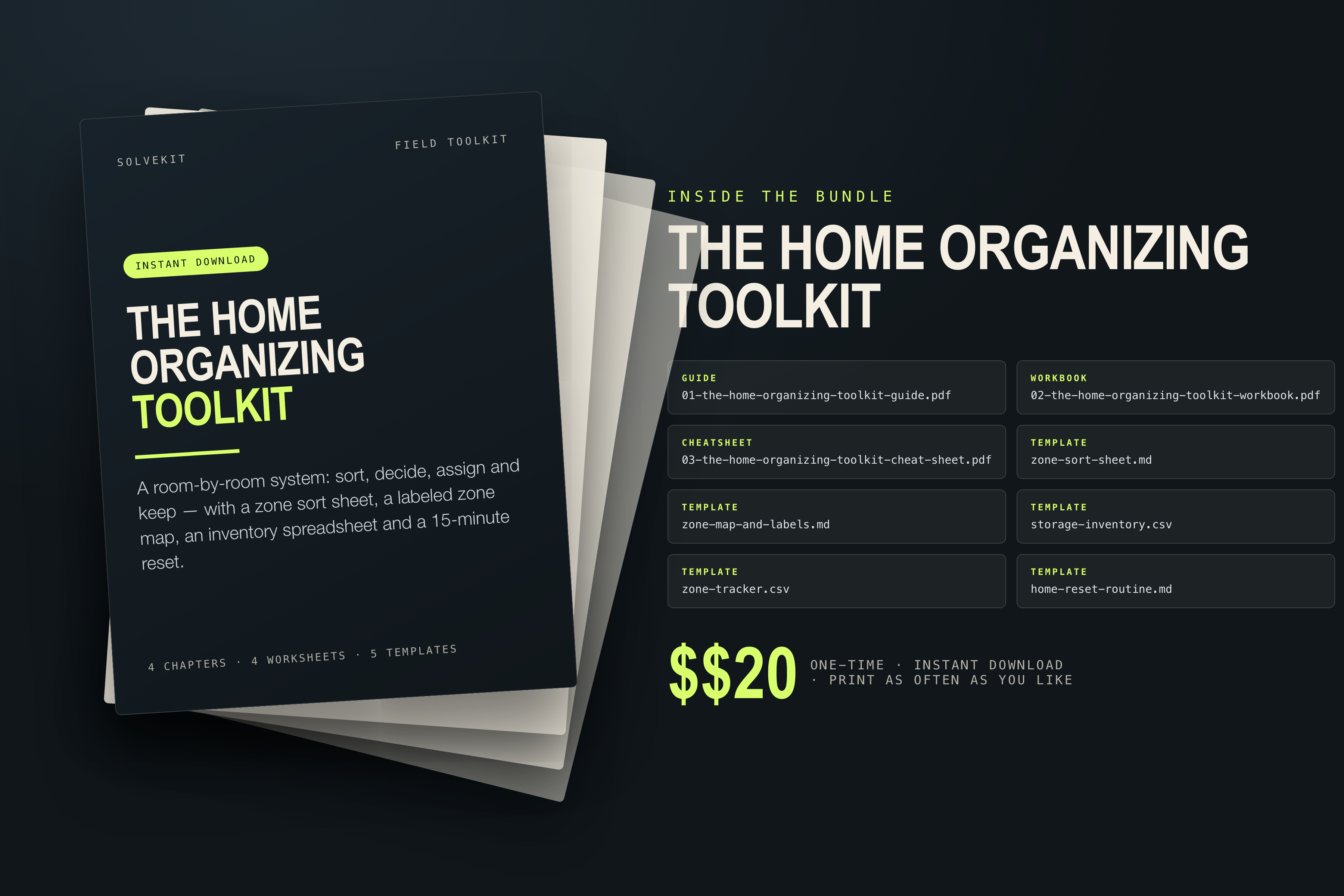
8 files, no login, no subscription, no upsell inside the folder.

guide 01-the-home-organizing-toolkit-guide.pdf The Home Organizing Toolkit
workbook 02-the-home-organizing-toolkit-workbook.pdf The Home Organizing Toolkit Workbook
cheatsheet 03-the-home-organizing-toolkit-cheat-sheet.pdf The Home Organizing Toolkit Cheat Sheet
template zone-sort-sheet.md Zone Sort Sheet
template zone-map-and-labels.md Zone Map & Labels
template storage-inventory.csv Storage Inventory (spreadsheet)
template zone-tracker.csv Zone Tracker (spreadsheet)
template home-reset-routine.md Home Reset Routine

First lines of storage-inventory.csv

space,category,item_count,capacity,label_word,container
Pantry shelf 1,snacks,,4,Snacks,bin
Pantry shelf 2,,,,,
Pantry shelf 3,,,,,
Kitchen drawer 1,,,,,
Kitchen drawer 2,,,,,
Hall closet,,,,,
Bedroom drawer,,,,,
Garage shelf,,,,,
,,,,,
,,,,,

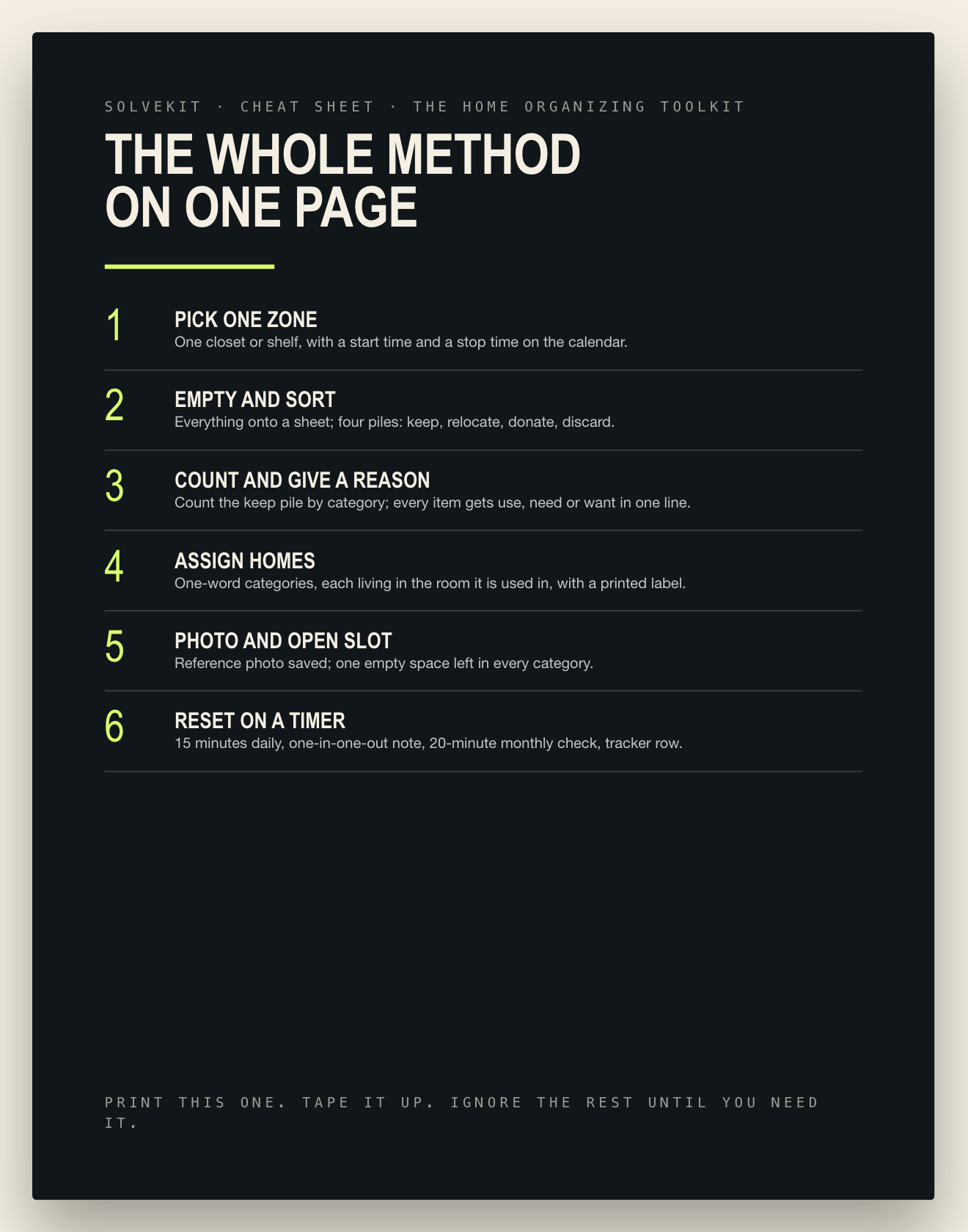
The whole method on one page

The Home Organizing Toolkit Cheat Sheet — print it for the fridge or send it to the group chat.

1
Pick one zone

One closet or shelf, with a start time and a stop time on the calendar.

2
Empty and sort

Everything onto a sheet; four piles: keep, relocate, donate, discard.

3
Count and give a reason

Count the keep pile by category; every item gets use, need or want in one line.

4
Assign homes

One-word categories, each living in the room it is used in, with a printed label.

5
Photo and open slot

Reference photo saved; one empty space left in every category.

6
Reset on a timer

15 minutes daily, one-in-one-out note, 20-minute monthly check, tracker row.

Look inside first

Real pages from the bundle, rendered at full resolution — nothing here is a mock-up of a different product.

Preview of Guide — first page
Guide — first page
Preview of Workbook — first worksheet
Workbook — first worksheet
Preview of Cheat sheet — one page
Cheat sheet — one page
Preview of The bundle
The bundle
Preview of Cover
Cover

The five templates, in plain language

Two are spreadsheets that add themselves up; three are printable pages.

  • Zone Sort Sheet — the pull-everything-out page: four piles, counts by category and a one-line reason behind every keep.
  • Zone Map & Labels — shelf-by-shelf homes for each category, with the label wording, capacity and container measurements.
  • Storage Inventory — a spreadsheet of space, category, count and capacity so a category never overfills its home (`.csv`).
  • Zone Tracker — one row per zone: date sorted, items kept and donated, reset routine, next check (`.csv`).
  • Home Reset Routine — the 15-minute daily reset and the 20-minute monthly check as checkboxes you can post inside the door.
  • Cheat Sheet — the whole six-step method on one printable page for the next room you tackle.

Questions, answered plainly

What exactly do I get?

A printable guide, a fill-in workbook, a one-page cheat sheet and five templates — three printable pages and two spreadsheets (`.csv`) that open in Google Sheets or Excel.

Which room should I start with?

The one you walk past every day and the smallest one that bothers you — a closet beats a garage for a first weekend. One zone, two hours, a stop time; finish that before choosing the next.

Do I need to buy bins and organizers?

Probably not. Measure the shelf first, sort and count, then use what you already own. Containers get bought only for a measured space holding a named category with a known capacity.

Does it cover the whole house at once?

No, on purpose. The tracker moves zone by zone so one space stays finished while the next one starts, and the reset routine is what keeps the finished ones finished.

How do I get it after paying?

The store emails the download link as soon as payment clears. It is a set of files, not a course, so there is nothing to wait for.

The honest bit

Read this before you buy. It matters more than any headline above.

What it isA file bundle: 3 PDFs and 5 templates. No login, no subscription, no course platform, no upsell inside.
What it is notNot a cleaning service, not a storage unit, and not help for hoarding — that needs a person, not a PDF.
No manufactured urgencyNo countdowns, strike-through prices, review stars or buyer counts appear on this page. The price is the price.
Print it freelyPrint as many copies as you like for yourself or your household. The examples are generic and contain no personal data.

Instant download · one-time payment

$20

Turn one messy space into a labeled system you can put back in ten minutes.

Get the toolkit — $20

Checkout runs on Gumroad. You get the download immediately after payment.

  • 01-the-home-organizing-toolkit-guide.pdf
  • 02-the-home-organizing-toolkit-workbook.pdf
  • 03-the-home-organizing-toolkit-cheat-sheet.pdf
  • zone-sort-sheet.md
  • zone-map-and-labels.md
  • storage-inventory.csv
  • zone-tracker.csv
  • home-reset-routine.md