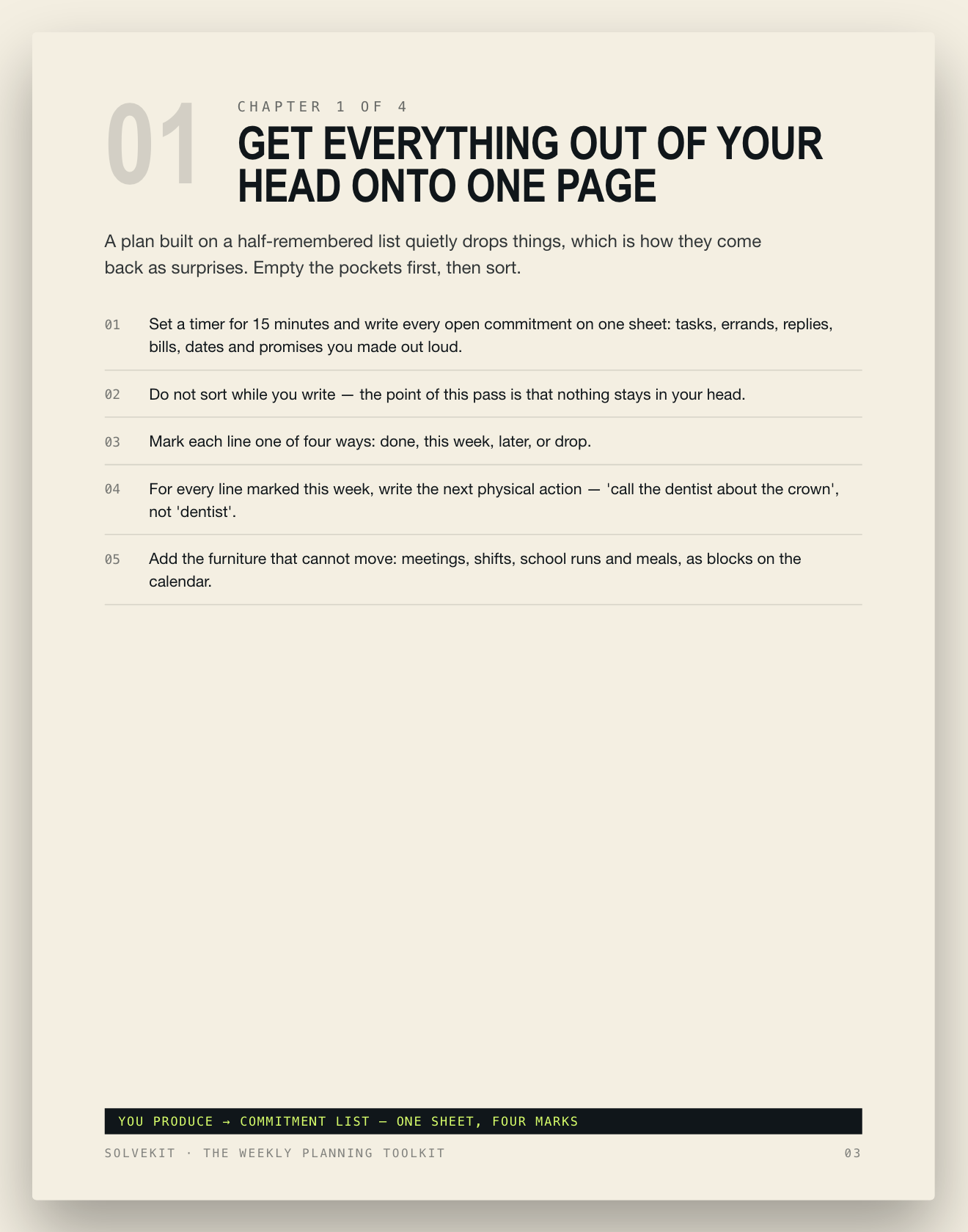
Get everything out of your head onto one page
A plan built on a half-remembered list quietly drops things, which is how they come back as surprises. Empty the pockets first, then sort.
answers “plan your week”
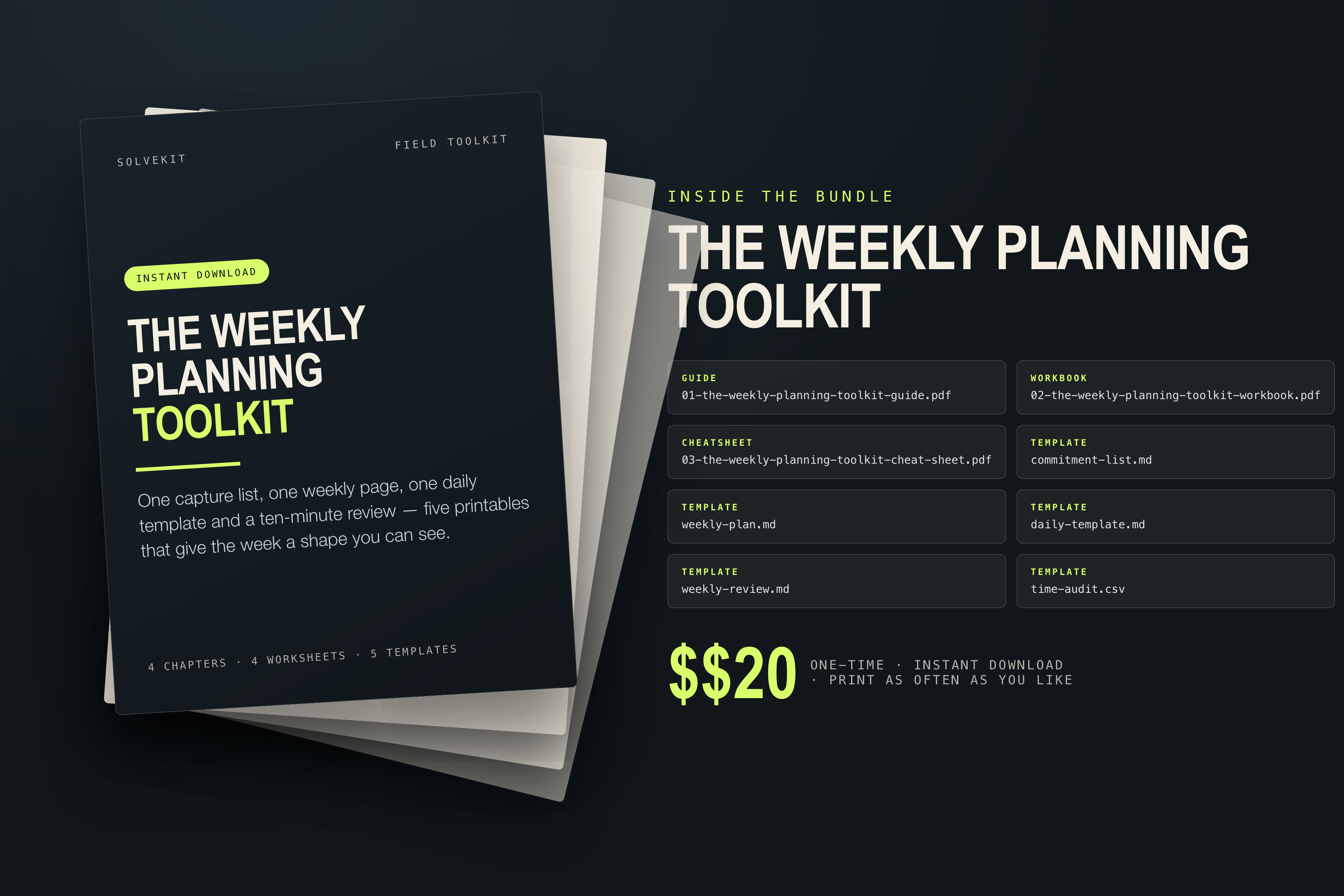
One capture list, one weekly page, one daily template and a ten-minute review — five printables that give the week a shape you can see.
Know what this week is for and what the next hour is for, without holding either in your head.
No invented pain points — these are the sentences the bundle was written against, taken from how people phrase the problem. Built for beginners.
Your commitments live in six places: a notes app, a calendar, a group chat and two scraps of paper.
The to-do list has thirty items on it and not one of them says when.
You start Monday with a clean calendar and fill it with other people's requests by Wednesday.
Everything is marked 'this week', so nothing has an order and the important thing waits behind four small ones.
The day ends earlier than your energy does, but you cannot say what the last hour was for.
Your commitments live on one page instead of in six places, the calendar holds three real blocks instead of twenty intentions, and Friday ends with a ten-minute review.
Reddit is not included: its anonymous API returns 403 from this machine. These are other people's public questions — proof the problem is asked a lot, not proof this product works. Read them yourself.
Each title links to the original thread in a new tab. The titles are quoted exactly, so if a site is unreachable from your network you can still find the thread by searching it.
Every chapter ends in something you keep and use — not a summary, an artifact.
A plan built on a half-remembered list quietly drops things, which is how they come back as surprises. Empty the pockets first, then sort.
A week with three real priorities beats a week with forty equal ones. Choose first, then find the time — never the other way round.
Decisions made once at 9am cost less than decisions made all day. A daily template removes the daily negotiation and protects the first hour.
Plans decay on contact with a real week. A short, fixed review at the same time each week is what keeps the system current instead of hopeful.
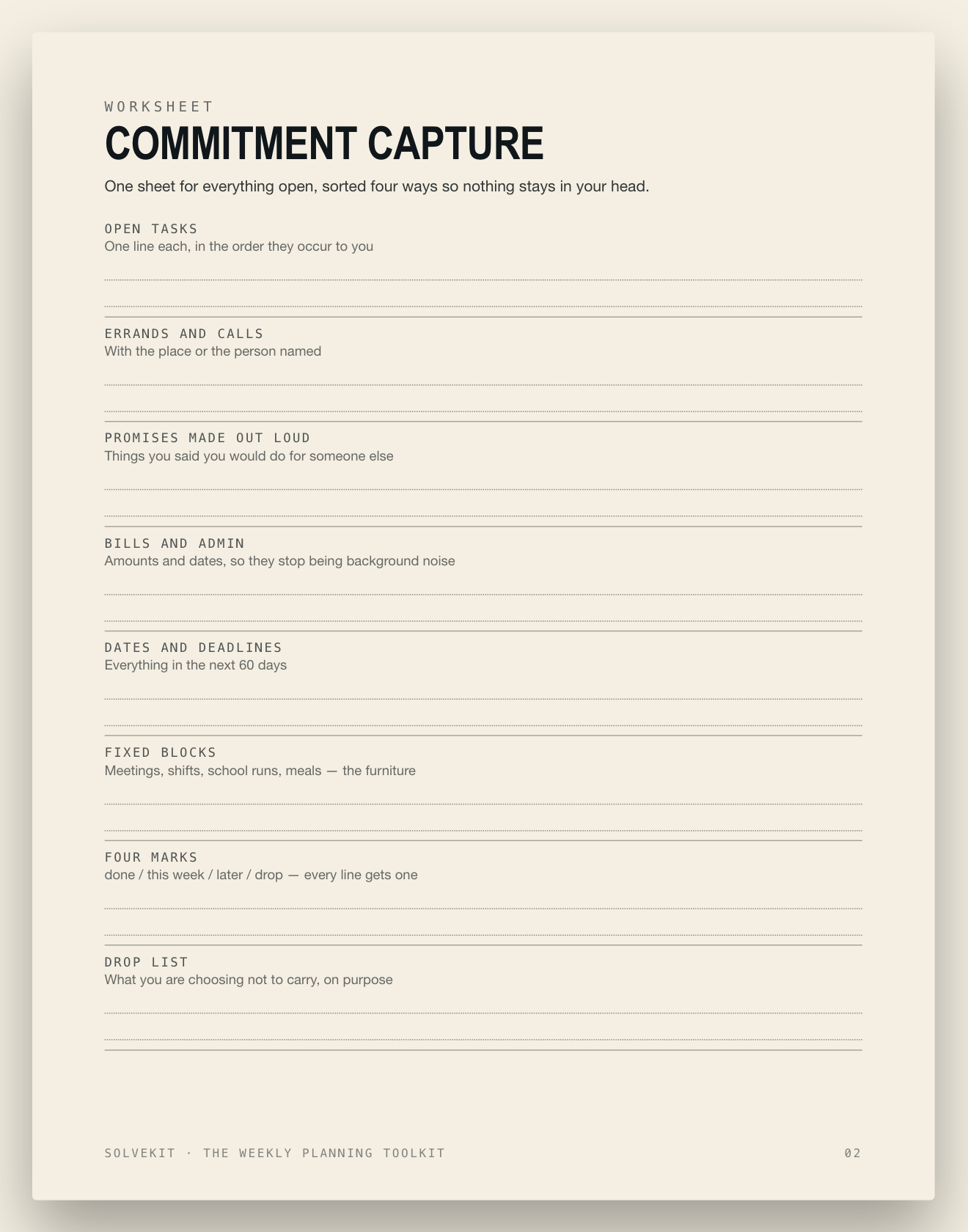
The Weekly Planning Toolkit Workbook — print it, fill it in, keep it next to the plan. 18 checklist items included.
One sheet for everything open, sorted four ways so nothing stays in your head.
The whole week on one page: three outcomes, three blocks, and what you decided not to do.
Five lines that give every day the same shape, printed and reused.
Ten minutes, same five questions, same time each week.
Each one appears in the guide with the fix beside it.
Thirty undated items force you to re-decide the priority every time you look at the list, which is why you look at it less each day.
→ Give every item a day or a named 90-minute block on the calendar before it counts as a plan.
A beautifully labeled system can still hold a week where nothing important was given a slot.
→ Write the three weekly outcomes first, and touch the colors, tags and apps only afterwards.
One overrun or one changed meeting makes the rest of the day's plan unusable, so the whole page gets abandoned.
→ Block three focus sessions, one admin window and one 30-minute gap, and leave the space between them open.
Work that did not finish never announces itself, so it quietly falls off and comes back as a scramble.
→ End each week with the same ten-minute review and carry unfinished lines forward with a new date or a drop.
8 files, no login, no subscription, no upsell inside the folder.
First lines of time-audit.csv
day,start,end,planned,actual_done,notes Mon,09:00,10:30,Deep work,Deep work, Mon,11:00,11:30,Replies and calls,Replies and calls, Tue,09:00,10:30,Deep work,, Tue,,,,, Wed,,,,, Thu,,,,, Fri,,,,, Sat,,,,, Sun,,,,,
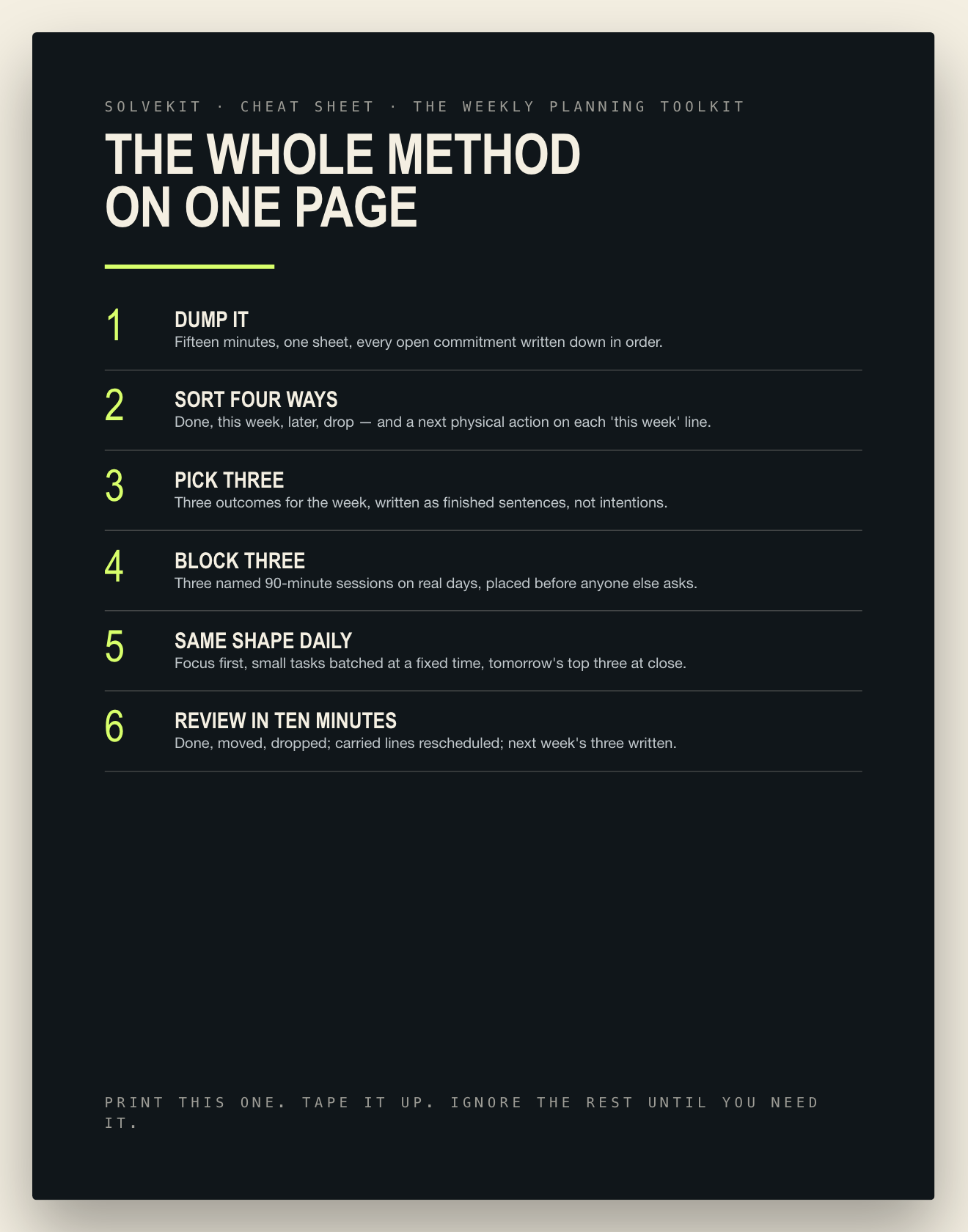
The Weekly Planning Toolkit Cheat Sheet — print it for the fridge or send it to the group chat.
Fifteen minutes, one sheet, every open commitment written down in order.
Done, this week, later, drop — and a next physical action on each 'this week' line.
Three outcomes for the week, written as finished sentences, not intentions.
Three named 90-minute sessions on real days, placed before anyone else asks.
Focus first, small tasks batched at a fixed time, tomorrow's top three at close.
Done, moved, dropped; carried lines rescheduled; next week's three written.
Real pages from the bundle, rendered at full resolution — nothing here is a mock-up of a different product.


Two are spreadsheets that add themselves up; three are printable pages.
A printable guide, a fill-in workbook, a one-page cheat sheet and five templates — one as a spreadsheet (`.csv`) that opens in Google Sheets or Excel, four as printable pages.
Neither. It is paper and one spreadsheet — no login, no notifications, nothing to set up. Print a page, write on it, reuse it next week.
That is what the template is built around: a 30-minute gap each day, and a review that moves unfinished lines to a new date or drops them on purpose instead of letting them pile up silently.
Start with the Commitment List and the Weekly Page — those two give the week a shape. The daily template and the review come in when you want the same shape each morning.
The download link arrives by email as soon as payment clears — it is a file, not a course, so there is nothing to wait for.
Read this before you buy. It matters more than any headline above.
Instant download · one-time payment
Checkout runs on Gumroad. You get the download immediately after payment.