$19 · instant download Get the toolkit — $19

answers “how to prepare for an interview”

The Interview Prep Toolkit

Everything you need before, during and after the interview: a role brief, a six-story bank, a drill sheet and the follow-up note — five pages you fill in and print.

Walk in with four pages: what the role asks, the stories you tell, the questions you ask, the note you send.

4chapters
4worksheets
5templates
8files

This is you, in 5 lines

No invented pain points — these are the sentences the bundle was written against, taken from how people phrase the problem. Built for the first time.

You read the posting three times and still cannot say what the role actually asks you to do.

Your answer to 'tell me about yourself' runs four minutes and never lands on the job.

You freeze on behavioral questions because every story you can remember is from a job you no longer do.

Research happens at 11pm in twenty tabs, and none of it ends up on a page you trust.

You leave the interview with a good feeling and no follow-up, so the silence does the talking.

what changes after

You stop cramming the night before. You know your six stories cold, you have a written answer for the question you were dreading, and you leave every interview with a thank-you out and a tracker row that shows the next step.

  • how to prepare for an interview

Why this keeps getting asked

Reddit is not included: its anonymous API returns 403 from this machine. These are other people's public questions — proof the problem is asked a lot, not proof this product works. Read them yourself.

Each title links to the original thread in a new tab. The titles are quoted exactly, so if a site is unreachable from your network you can still find the thread by searching it.

Four chapters, each ending in a page

Every chapter ends in something you keep and use — not a summary, an artifact.

01

Turn the posting into a checklist

Practice without a target is noise. The posting names the three capabilities they score you on and what the recruiter screens for first, so every answer you prepare has somewhere to land.

01Paste the full posting into the Role Fit Worksheet and underline the three phrases that repeat or sit under 'responsibilities'.
02Split that list into required and nice-to-have — the required column is exactly what they screen your resume against.
03Write the first-90-day outcomes: three things this person owns in their first quarter, one line each, in your own words.
04Add four company facts you checked yourself — product, size, stage, and who you would report to — with the page you read them on.
05Name the gap you cannot close and write the one-sentence answer you will give if they raise it.
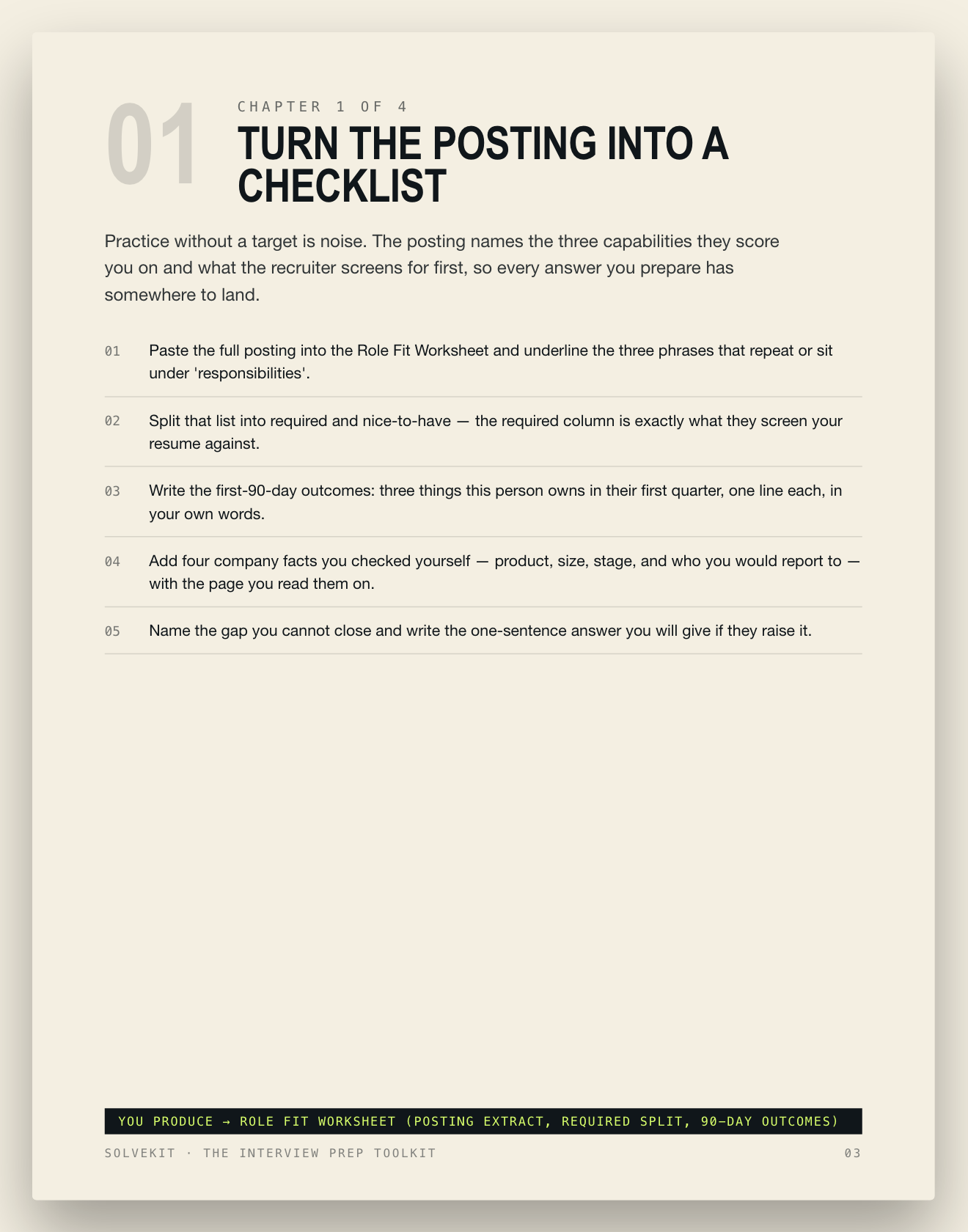
you finish with: Role Fit Worksheet (posting extract, required split, 90-day outcomes)
02

Bank six stories you can tell in ninety seconds

Every behavioral question is asking for one thing: a story with an ending. Six four-beat stories tagged to the skills in the posting cover most of what they will ask you.

01Pick six situations from work, school, volunteering or a side project where something changed because of what you did.
02Write each story in four beats — situation, task, action, result — and keep the spoken version under ninety seconds.
03Tag each story with the two capabilities from the posting that it proves, so you can choose the right one mid-question.
04Cut the jargon and any story that needs more than two sentences of setup; the listener should know where they are within ten seconds.
05Rehearse the three weakest stories out loud, standing, timed on your phone — read from the four beats, never from a script.
you finish with: Story Bank (six stories, four beats, skill tags)
03

Drill the answers and write your five questions

Answers you have written once come back faster under pressure, and the questions you ask are the one part of the interview you control completely.

01Answer the twelve questions on the drill sheet in writing — one short paragraph each, not a script to memorize.
02Write your sixty-second opener for 'tell me about yourself': where you are now, what you did, why this role.
03Draft the three hard answers on paper — the gap, the short stint, the reason you are leaving — in two sentences each.
04Write five questions for them, each rooted in the posting: the first quarter, the team, how success is measured.
05Run one timed mock round with a friend or record yourself, then mark the two answers that ran long.
you finish with: Question Drill Sheet + five questions to ask
04

Close the loop and track every stage

The interview does not end at the door. A note within a day and one tracker row are what keep a second-round date from slipping past unnoticed.

01Send the thank-you note within twenty-four hours: one thing you discussed, one reason you want the role, one next step.
02Add every new question they asked you to the drill sheet before the next round — the same questions tend to come back.
03Update the tracker the same day: company, stage, contact, last touch, and the date the next step is owed to you.
04Write your salary baseline before the call — the number you would accept and the line you will use if they ask what you earn now.
you finish with: Thank-you note + interview tracker row

The workbook

The Interview Prep Toolkit Workbook — print it, fill it in, keep it next to the plan. 18 checklist items included.

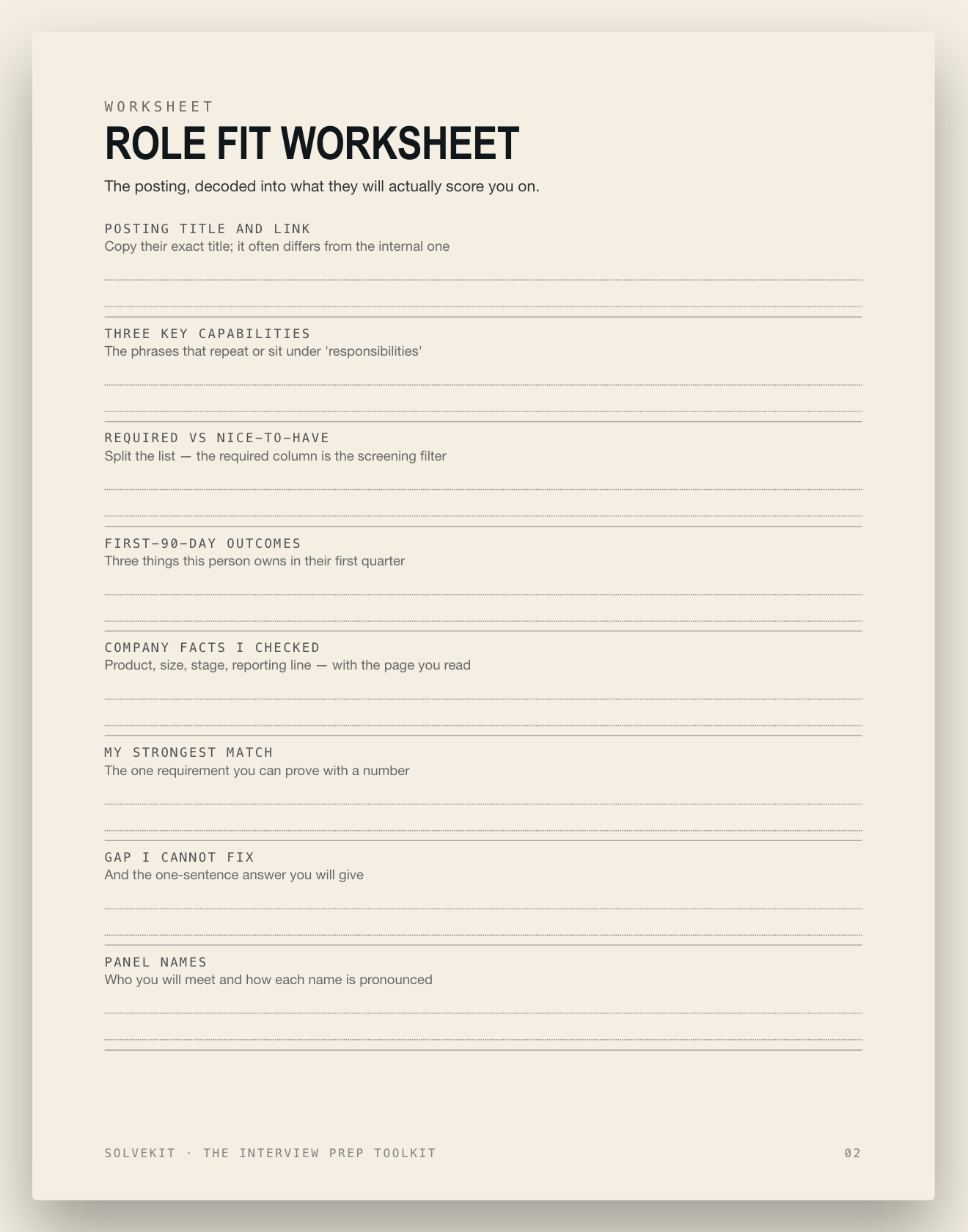
Role Fit Worksheet

The posting, decoded into what they will actually score you on.

Posting title and linkThree key capabilitiesRequired vs nice-to-haveFirst-90-day outcomesCompany facts I checkedMy strongest matchGap I cannot fix

Story Bank

Six stories, four beats each — enough for almost any behavioral question.

Story 1 — four beatsStory 2 — four beatsStory 3 — four beatsStory 4 — four beatsStory 5 — four beatsStory 6 — four beatsSkill tags

Question Drill Sheet

The questions you are most likely to hear, answered in your own words.

Tell me about yourselfWhy this company and this roleGreatest strengthA weakness you work onConflict with a teammate or managerA time you missed a targetThe gap, the short stint, the leaving

Follow-up & Offer Tracker

One row per application — what happened, when, and what you owe them next.

Company and roleStageRecruiter or contactLast contact dateNext step and dateQuestions they asked meThank-you sent

Mistakes the method prevents

Each one appears in the guide with the fix beside it.

Cramming the posting the night before

You memorize words instead of fit, so the moment a question is phrased differently the answer is gone.

→ Turn the posting into the Role Fit Worksheet two days out and rehearse from that one page.

Memorizing full scripts

One forgotten line collapses the whole answer into silence, and you stop listening to the actual question.

→ Learn the four beats of each story and let the wording come out differently every time.

Opening 'tell me about yourself' with your life story

Four minutes of biography answers none of what they need to know about this role.

→ Sixty seconds: now, what you did, why this role — then stop talking.

Going quiet after the interview

No note and no tracker row means a follow-up date passes unnoticed and the silence reads as a decision.

→ Thank-you note within twenty-four hours, tracker updated the same day.

  • Job posting pasted into the Role Fit Worksheet, three key capabilities underlined
  • Required vs nice-to-have split written out
  • First-90-day outcomes drafted, one line each
  • Four company facts checked: product, size, stage, reporting line
  • The gap I cannot fix, plus my one-sentence answer
  • Six stories written in four beats, each under ninety seconds
  • Every story tagged with the two skills it proves
  • Sixty-second 'tell me about yourself' written and spoken out loud
  • Twelve drill questions answered in writing, one paragraph each
  • Three hard answers drafted: gap, short stint, reason for leaving
  • Five questions written for them, each rooted in the posting
  • Resume printed in the version I actually submitted

Exactly what downloads

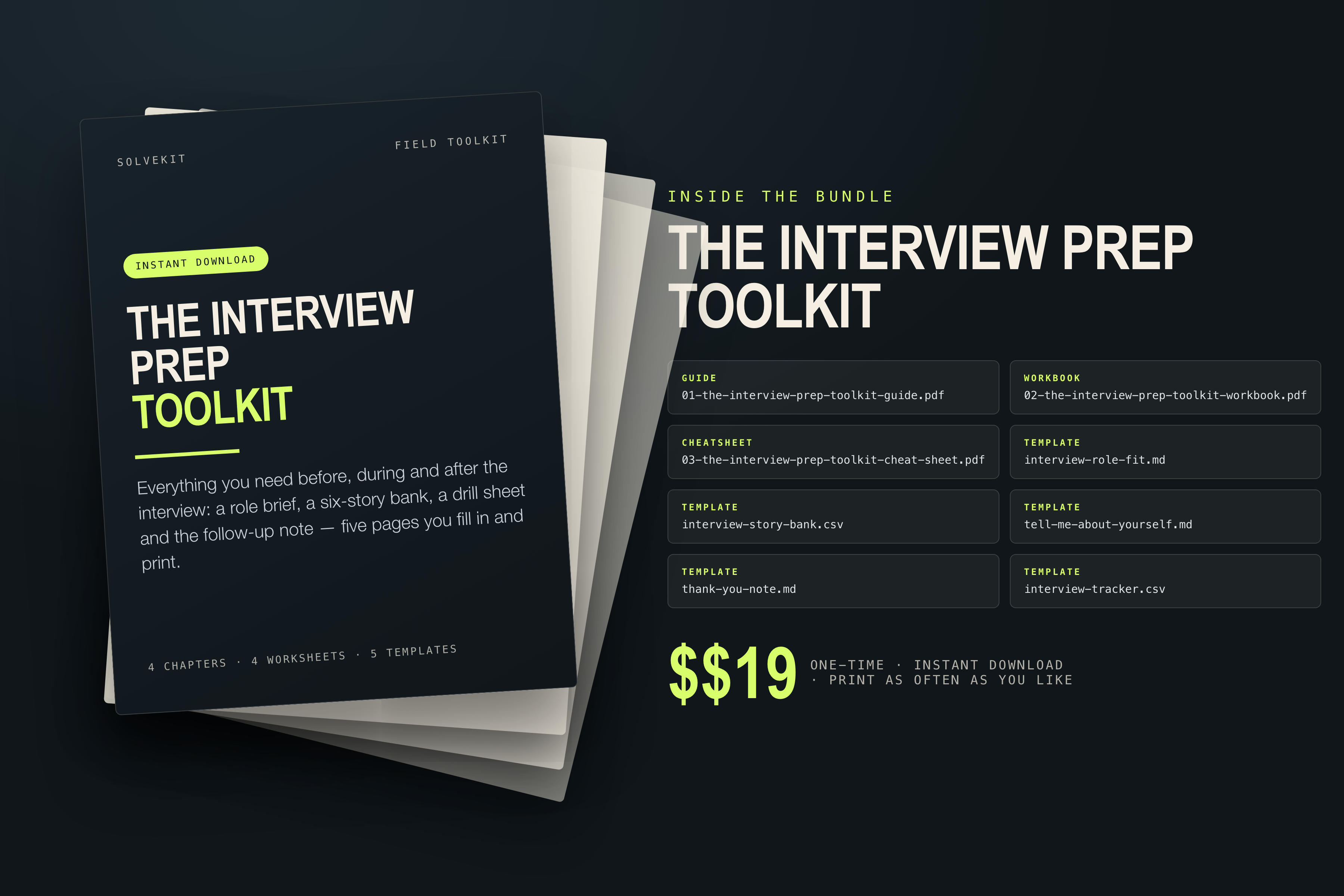
8 files, no login, no subscription, no upsell inside the folder.

guide 01-the-interview-prep-toolkit-guide.pdf The Interview Prep Toolkit
workbook 02-the-interview-prep-toolkit-workbook.pdf The Interview Prep Toolkit Workbook
cheatsheet 03-the-interview-prep-toolkit-cheat-sheet.pdf The Interview Prep Toolkit Cheat Sheet
template interview-role-fit.md Role Fit Worksheet
template interview-story-bank.csv Story Bank (spreadsheet)
template tell-me-about-yourself.md Tell Me About Yourself (60 seconds)
template thank-you-note.md Thank-You Note
template interview-tracker.csv Interview Tracker (spreadsheet)

First lines of interview-story-bank.csv

id,headline,skills_proven,situation,task,action,result
story_1,example: conflict with a teammate,,,,,
story_2,,,,,,
story_3,,,,,,
story_4,,,,,,
story_5,,,,,,
story_6,,,,,,

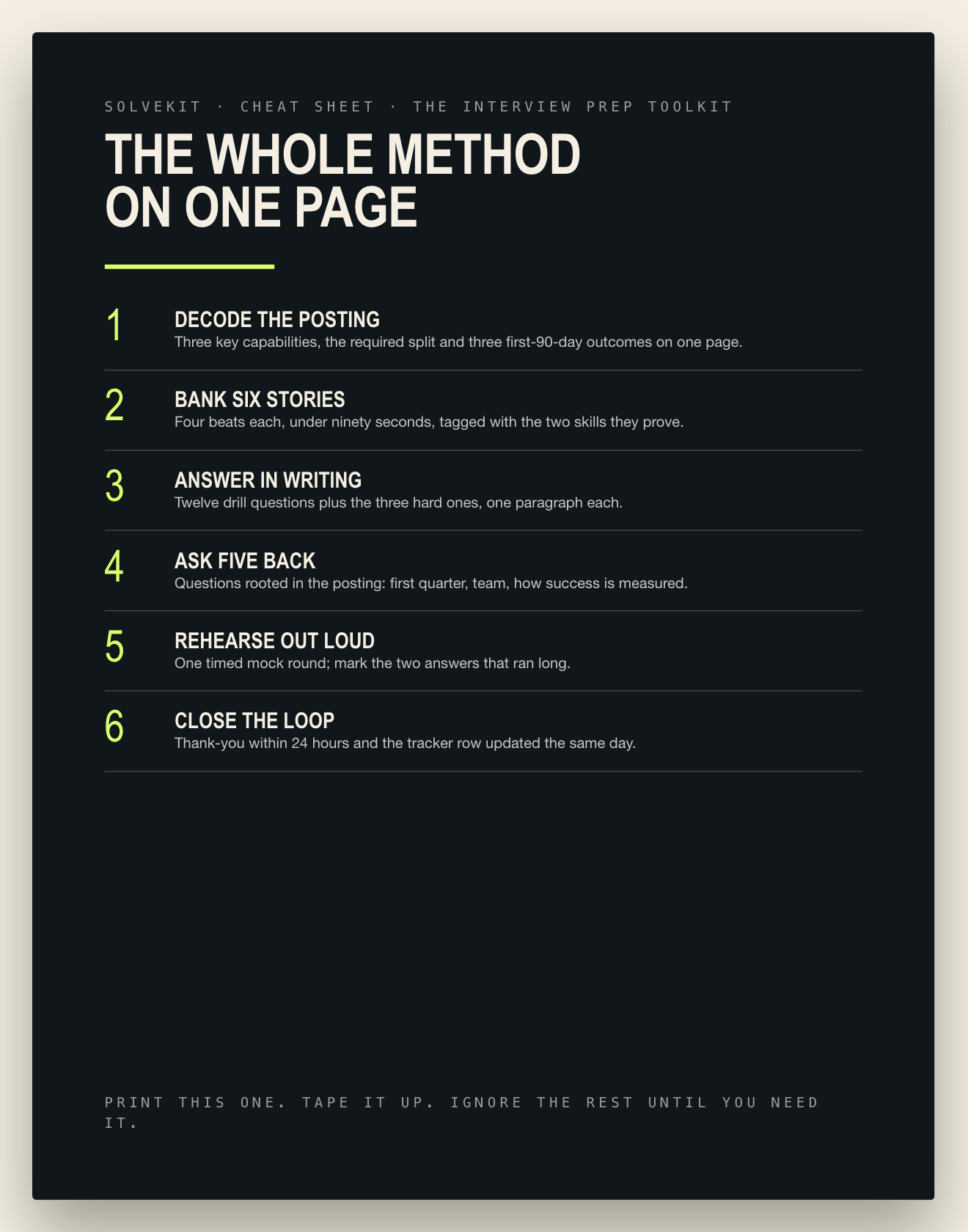
The whole method on one page

The Interview Prep Toolkit Cheat Sheet — print it for the fridge or send it to the group chat.

1
Decode the posting

Three key capabilities, the required split and three first-90-day outcomes on one page.

2
Bank six stories

Four beats each, under ninety seconds, tagged with the two skills they prove.

3
Answer in writing

Twelve drill questions plus the three hard ones, one paragraph each.

4
Ask five back

Questions rooted in the posting: first quarter, team, how success is measured.

5
Rehearse out loud

One timed mock round; mark the two answers that ran long.

6
Close the loop

Thank-you within 24 hours and the tracker row updated the same day.

Look inside first

Real pages from the bundle, rendered at full resolution — nothing here is a mock-up of a different product.

Preview of Guide — first page
Guide — first page
Preview of Workbook — first worksheet
Workbook — first worksheet
Preview of Cheat sheet — one page
Cheat sheet — one page
Preview of The bundle
The bundle
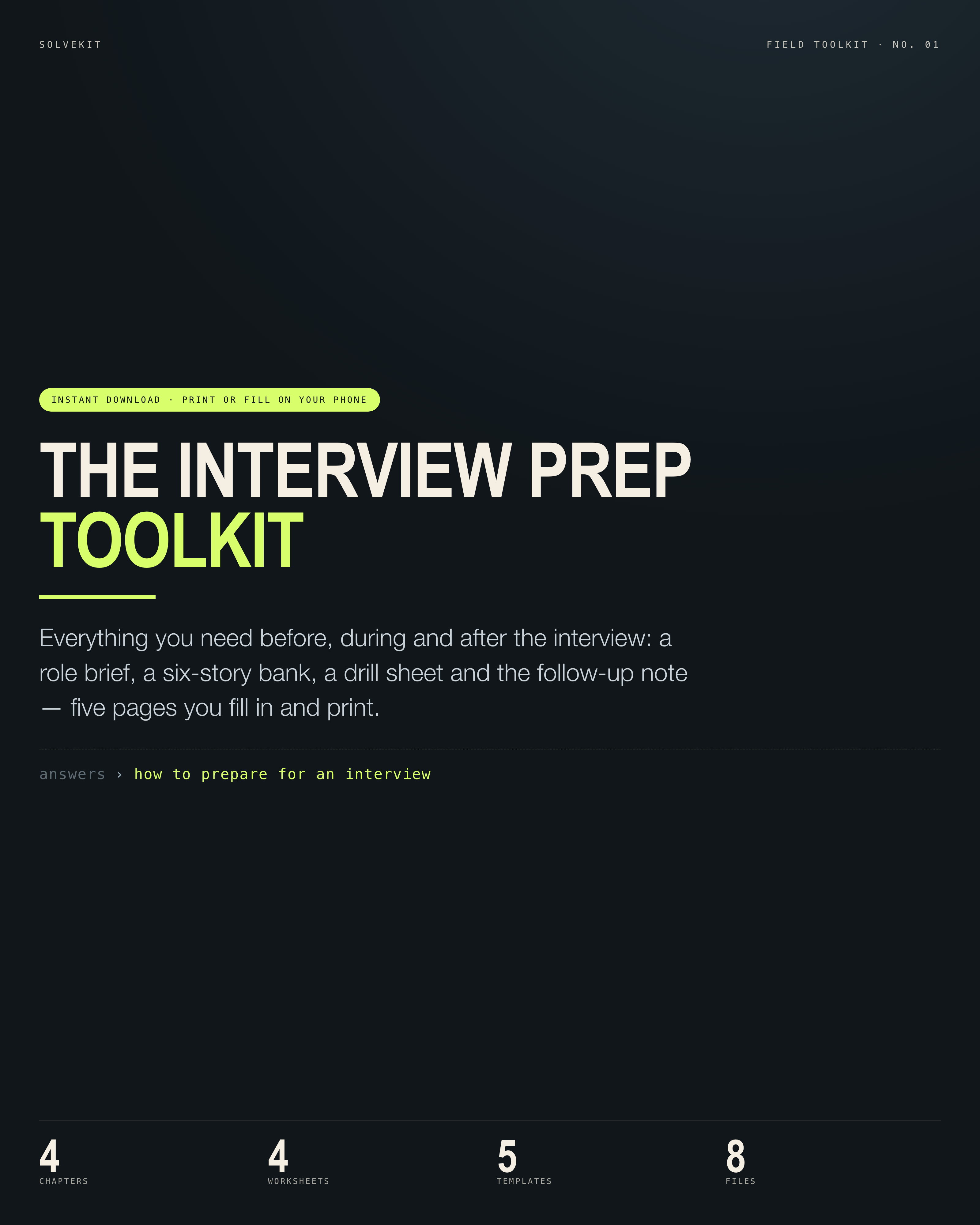
Preview of Cover
Cover

The five templates, in plain language

Two are spreadsheets that add themselves up; three are printable pages.

  • Role Fit Worksheet — the posting decoded into key capabilities, the required split and three first-90-day outcomes.
  • Story Bank — six stories in four beats, tagged with the skills they prove, as a spreadsheet you can sort (`.csv`).
  • Tell Me About Yourself — the sixty-second now, did, why-this-role structure with blanks and a shorter phone-screen version.
  • Question Drill Sheet — room for your paragraph answer to each likely question, plus the five you will ask them.
  • Interview Tracker — one row per application: stage, dates, contact and the next step you owe them (`.csv`).
  • Cheat Sheet — the whole six-step method on one printable page for the week before the interview.

Questions, answered plainly

What exactly do I get?

A printable guide, a fill-in workbook, a one-page cheat sheet and five templates — three printable pages and two spreadsheets (`.csv`) that open in Google Sheets or Excel.

I have the interview in two days. Is that enough time?

The order is what saves you: Role Fit Worksheet first, story bank second, drill sheet third. Two focused afternoons cover all three, and the cheat sheet is what you read on the morning of.

Does it give me answers to memorize?

No. Scripts break the moment a question is worded differently. It gives you structures — four beats per story, a sixty-second opener, a one-line answer for the gap — and the words stay yours.

Is this only for office jobs?

No. The same pages work for a first job, a promotion interview, a panel with three strangers or a five-minute phone screen — the fields do not care what the role is.

How do I get it after paying?

The store emails the download link as soon as payment clears. It is a set of files, not a course, so there is nothing to wait for.

The honest bit

Read this before you buy. It matters more than any headline above.

What it isA file bundle: 3 PDFs and 5 templates. No login, no subscription, no course platform, no upsell inside.
What it is notNot a recruiter, not a coaching service, and not a promise that any application will succeed.
No manufactured urgencyNo countdowns, strike-through prices, review stars or buyer counts appear on this page. The price is the price.
Print it freelyPrint as many copies as you like for yourself or your household. The examples are generic and contain no personal data.

Instant download · one-time payment

$19

Walk in with four pages: what the role asks, the stories you tell, the questions you ask, the note you send.

Get the toolkit — $19

Checkout runs on Gumroad. You get the download immediately after payment.

  • 01-the-interview-prep-toolkit-guide.pdf
  • 02-the-interview-prep-toolkit-workbook.pdf
  • 03-the-interview-prep-toolkit-cheat-sheet.pdf
  • interview-role-fit.md
  • interview-story-bank.csv
  • tell-me-about-yourself.md
  • thank-you-note.md
  • interview-tracker.csv