$21 · instant download Get the toolkit — $21

answers “study for the sat”

The Study System Toolkit

An exam map, a question bank, a review schedule and a past-paper debrief — five templates that turn your notes into answers you can write under time.

Know exactly what to review today, and have already answered the question types waiting for you.

4chapters
4worksheets
5templates
8files

This is you, in 5 lines

No invented pain points — these are the sentences the bundle was written against, taken from how people phrase the problem. Built for beginners.

You reread the same highlighted page and can recite almost none of it.

You know which chapter you like and have never counted how many marks each topic is worth.

Revision happens in one long night before the paper and leaks away by the second question.

You do practice questions with the book open, so you recognize the answer instead of producing it.

Your plan says 'do chemistry' with no number attached, so you stop after twenty minutes.

what changes after

You walk into the paper having tested yourself on those topics on a schedule — instead of rereading notes you have read four times and hoping they stick on the morning.

  • study for the sat

Why this keeps getting asked

Reddit is not included: its anonymous API returns 403 from this machine. These are other people's public questions — proof the problem is asked a lot, not proof this product works. Read them yourself.

Each title links to the original thread in a new tab. The titles are quoted exactly, so if a site is unreachable from your network you can still find the thread by searching it.

Four chapters, each ending in a page

Every chapter ends in something you keep and use — not a summary, an artifact.

01

Map the exam before you revise it

You cannot plan work you have never seen on one page. Weighting topics by marks is what makes effort follow reward instead of mood.

01List every topic from the syllabus or spec on one page, one line each, numbered.
02Write the marks or weight each topic carries beside it, taken from the spec or from past papers you already hold.
03Rate your confidence in each topic 1 to 5 honestly, with no credit for how much you enjoy it.
04Book every paper's date, start time and length on the calendar, plus any coursework deadlines.
05Circle the five topics carrying the most marks that you rated 3 or below — those five are the plan.
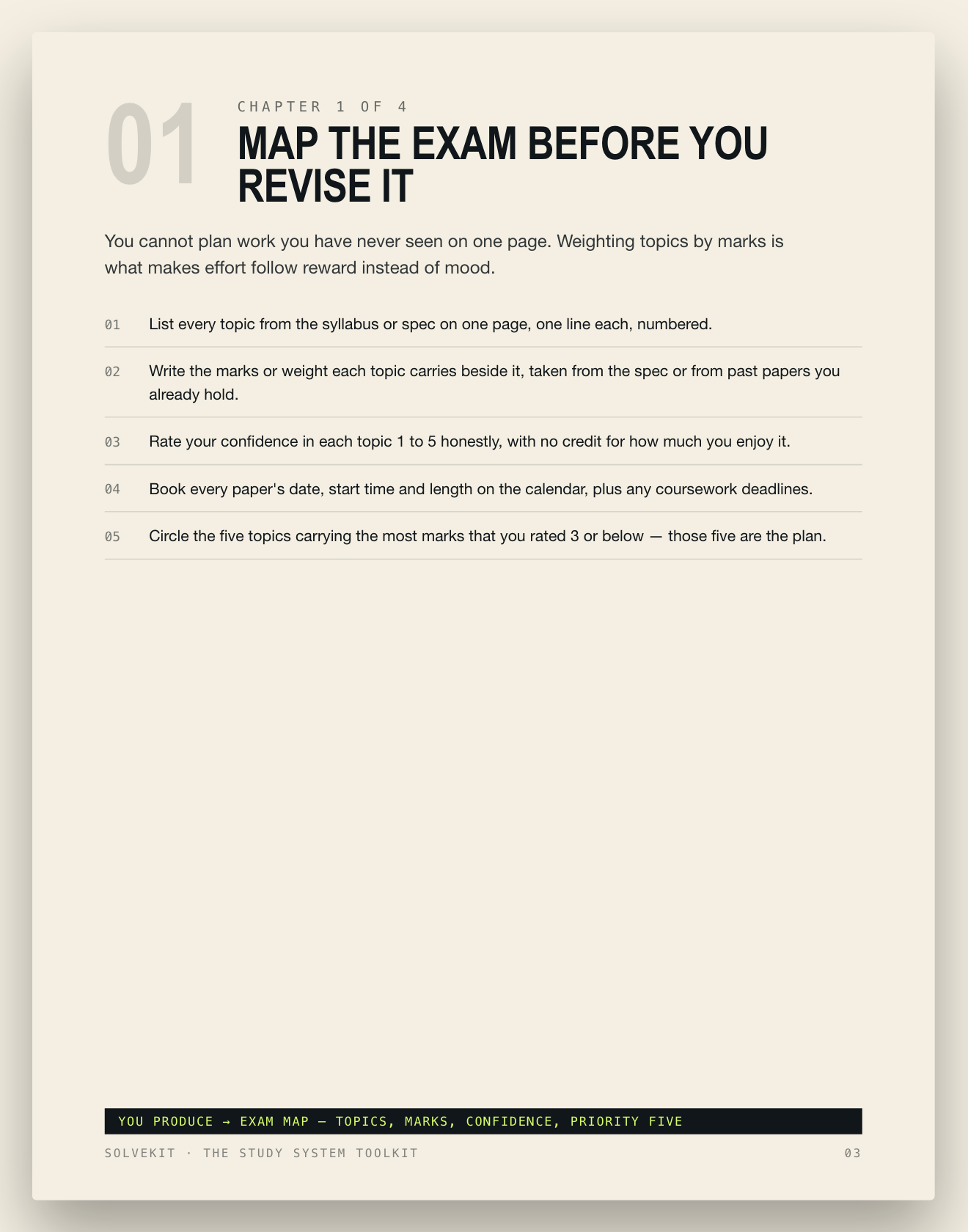
you finish with: Exam Map — topics, marks, confidence, priority five
02

Turn your notes into questions

Reading is recognition; answering is recall. This phase converts your material into things that can actually test you.

01Take one topic and write 10 questions on it in your own words — short answers and problems, not multiple choice.
02Keep the rule that makes it work: no book open while writing the question; open it only to check the answer.
03Number each question and file it in the question bank with its topic and source (page, video timestamp, past paper).
04Open every session by answering three old questions cold, before you look at any notes at all.
05Mark your own answer against the mark scheme and write the lost mark next to the question it came from.
you finish with: Question Bank — numbered, topic-tagged, sourced
03

Put review on a dated schedule

A topic met once is a topic gone by exam week. Spacing the same questions across days is what makes them available when you need them.

01Book three review blocks per topic: the day after, three days after, and three weeks after you first learn it.
02Give every block a count — 15 questions, 20 minutes, or one paper section. A session with no number does not happen.
03Rotate topics so no subject gets two sessions in a row, and change format on each pass: questions, then a 3-minute teach-out-loud, then key points from memory.
04Score each pass out of the count you set, and move any topic under your own threshold back to the front of the queue with 10 fresh questions.
05Protect the blocks in the calendar like classes: same time, same place, phone in another room.
you finish with: Review Schedule — dated blocks with counts
04

Sit real papers, then debrief them

Timed papers find the gaps a quiet desk hides. The mark you keep is the one you write down afterwards and act on before the next paper.

01Sit one full past paper under exact conditions: same length, no notes, no phone, start time written on the sheet.
02Mark it against the official scheme within 24 hours, while your reasoning is still fresh.
03Log every lost mark by reason rather than by score: never learned it, forgot it, misread the question, ran out of time.
04Turn each reason into a booked action — a new question set, a timed drill, or the topic back onto the review schedule.
05In the final three days, review only debriefs and your question bank; schedule no new material that late.
you finish with: Past Paper Debrief — lost marks by reason

The workbook

The Study System Toolkit Workbook — print it, fill it in, keep it next to the plan. 18 checklist items included.

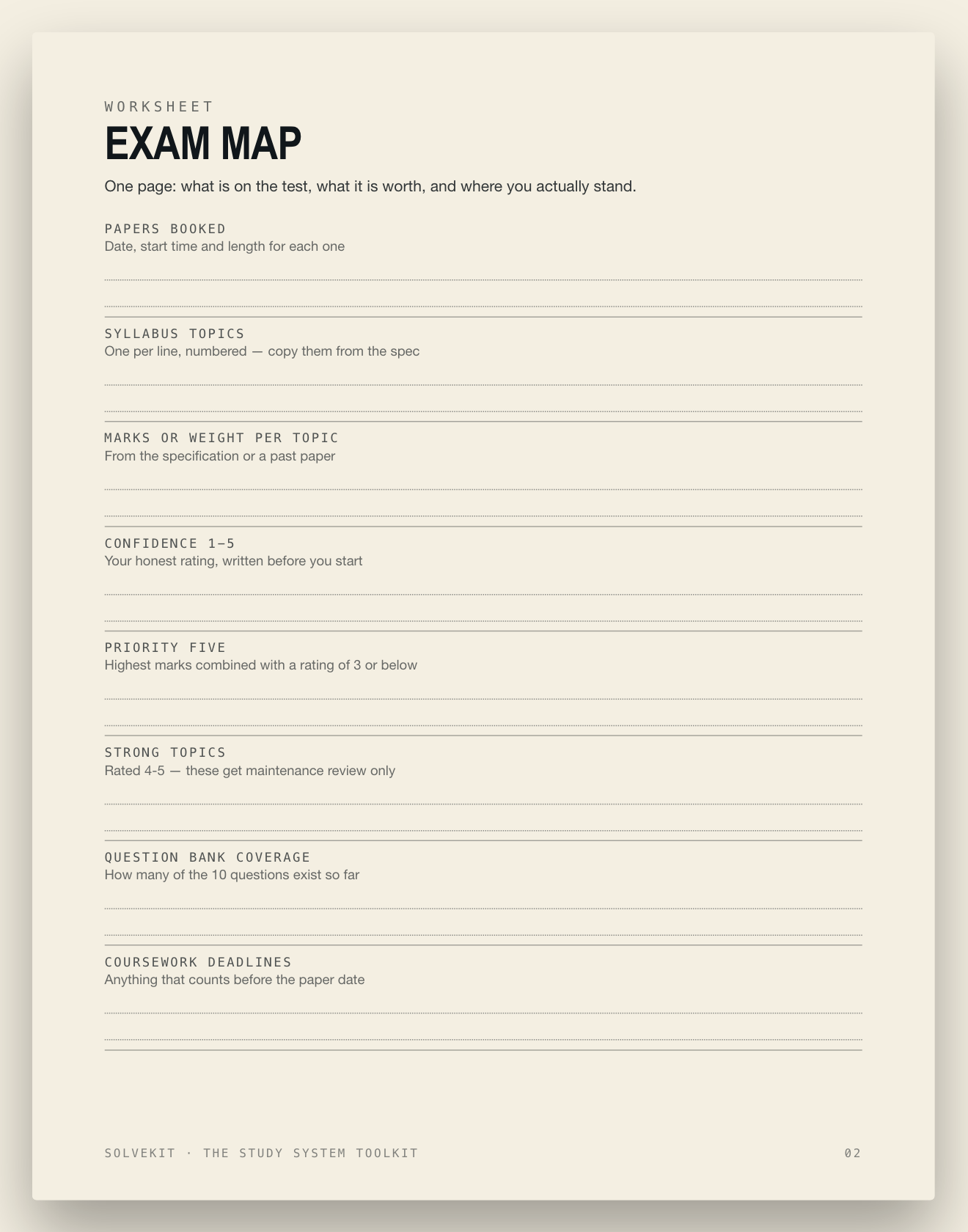
Exam Map

One page: what is on the test, what it is worth, and where you actually stand.

Papers bookedSyllabus topicsMarks or weight per topicConfidence 1-5Priority fiveStrong topicsQuestion bank coverage

Question Bank Sheet

Where your 10-per-topic questions live so they can come back on a schedule.

Question numberTopicSourceQuestionAnswer (one line)Mark scheme pointsNext review date

Review Schedule

Dated blocks with counts, so a session is a number on the calendar instead of a mood.

TopicFirst learning dateReview 1 (+1 day)Review 2 (+3 days)Review 3 (+21 days)Format for this passResult

Past Paper Debrief

The score is the least useful part of a paper; the reasons are what you study next.

Paper and dateTime usedMarks by sectionNever learned itForgot itMisread or ran out of timeFix booked

Mistakes the method prevents

Each one appears in the guide with the fix beside it.

Rereading and highlighting

It feels productive because it is comfortable, but a page you can recognize is not a page you can write from memory.

→ After each read, close the book and write everything you remember on a blank sheet, then fill the gaps in a second color.

Cramming the night before

One long session packs the whole subject into a single sitting that starts fading the moment the paper ends.

→ Book four shorter sessions across the week as dated blocks with question counts, and keep the night before for sleep.

Practising open-book

Looking things up trains recognition, and the exam only offers production under a clock.

→ Every practice answer is written with the book closed, then checked and marked against the scheme.

Chasing the topics you enjoy

The topics you like are usually the ones you already know, so the hours go where the marks already are.

→ Sort the exam map by marks and confidence, and start each session with the highest-weight topic you rated lowest.

  • Every syllabus topic listed on one page, one line each
  • Marks or weight written next to each topic from the spec
  • Confidence rated 1-5 per topic, honestly and without rounding up
  • Five priority topics circled: highest marks, lowest confidence
  • Every paper's date, start time and length on the calendar
  • Coursework and assignment deadlines on that same calendar
  • 10 questions written per priority topic, book closed while writing
  • Question bank numbered, with topic and source on every line
  • Three review blocks booked per topic: +1 day, +3 days, +21 days
  • Each session carries a number: questions, minutes or paper section
  • Three old questions answered cold at the start of every session
  • One full past paper sat under timed conditions this week

Exactly what downloads

8 files, no login, no subscription, no upsell inside the folder.

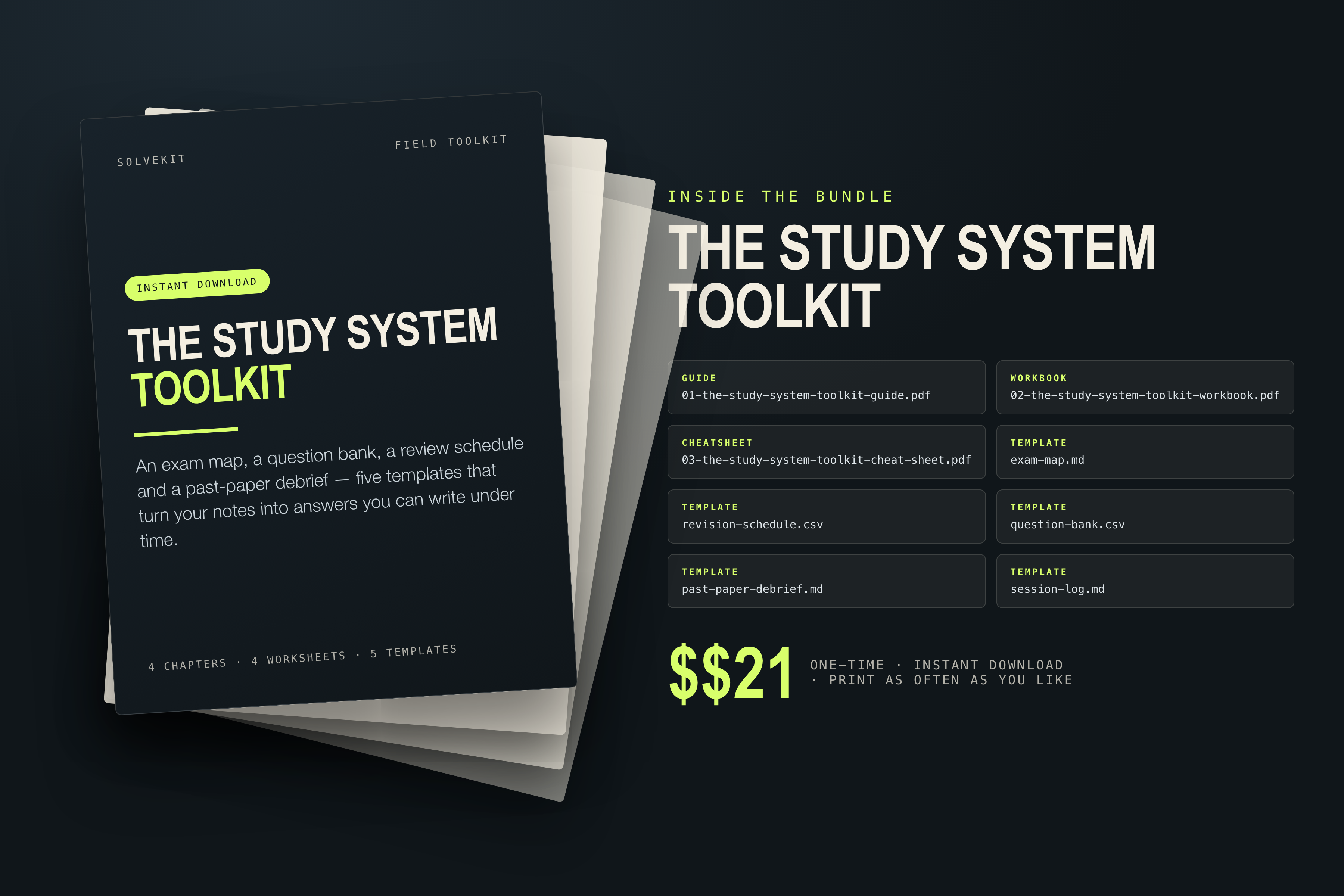
guide 01-the-study-system-toolkit-guide.pdf The Study System Toolkit
workbook 02-the-study-system-toolkit-workbook.pdf The Study System Toolkit Workbook
cheatsheet 03-the-study-system-toolkit-cheat-sheet.pdf The Study System Toolkit Cheat Sheet
template exam-map.md Exam Map
template revision-schedule.csv Review Schedule (spreadsheet)
template question-bank.csv Question Bank (spreadsheet)
template past-paper-debrief.md Past Paper Debrief
template session-log.md Study Session Log

First lines of revision-schedule.csv

topic,first_learned,review_1,review_2,review_3,session_count,result
Example topic,2026-05-10,2026-05-11,2026-05-13,2026-05-31,15 questions,
,,,,,,
,,,,,,
,,,,,,
,,,,,,
,,,,,,
,,,,,,
,,,,,,
,,,,,,
,,,,,,

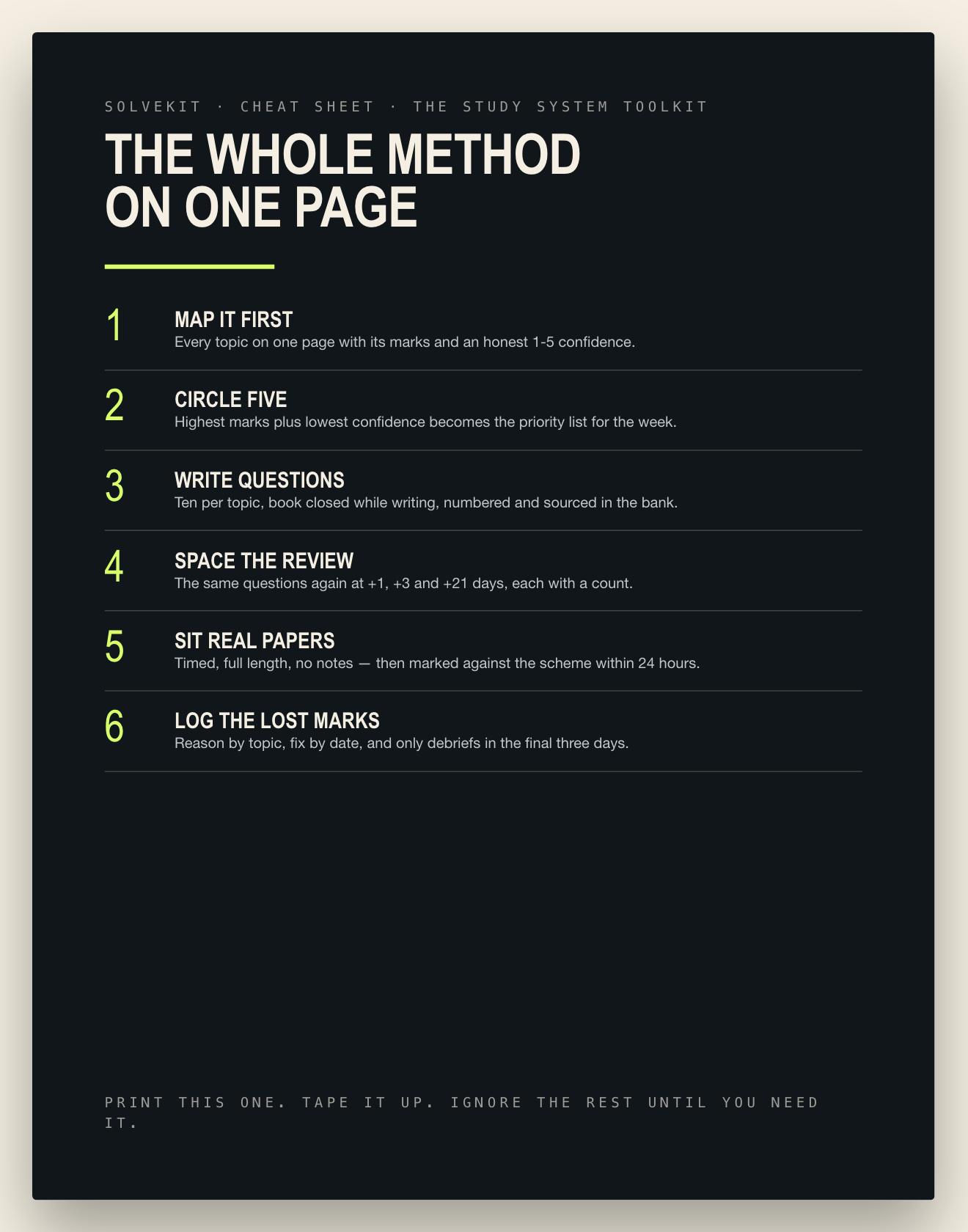
The whole method on one page

The Study System Toolkit Cheat Sheet — print it for the fridge or send it to the group chat.

1
Map it first

Every topic on one page with its marks and an honest 1-5 confidence.

2
Circle five

Highest marks plus lowest confidence becomes the priority list for the week.

3
Write questions

Ten per topic, book closed while writing, numbered and sourced in the bank.

4
Space the review

The same questions again at +1, +3 and +21 days, each with a count.

5
Sit real papers

Timed, full length, no notes — then marked against the scheme within 24 hours.

6
Log the lost marks

Reason by topic, fix by date, and only debriefs in the final three days.

Look inside first

Real pages from the bundle, rendered at full resolution — nothing here is a mock-up of a different product.

Preview of Guide — first page
Guide — first page
Preview of Workbook — first worksheet
Workbook — first worksheet
Preview of Cheat sheet — one page
Cheat sheet — one page
Preview of The bundle
The bundle
Preview of Cover
Cover

The five templates, in plain language

Two are spreadsheets that add themselves up; three are printable pages.

  • Exam Map — every topic, its marks and your 1-5 confidence, so the hours land where the points are.
  • Question Bank — numbered questions tagged by topic and source, ready to resurface on a schedule (`.csv`).
  • Review Schedule — dated blocks at +1, +3 and +21 days, each with a question or minute count (`.csv`).
  • Past Paper Debrief — lost marks logged by reason with one booked fix per reason, instead of just a score.
  • Session Log — the count you set, the count you got, and the first action for next time.
  • Cheat Sheet — the six-step method on one printable page for the front of your folder.

Questions, answered plainly

What exactly do I get?

A printable guide, a fill-in workbook, a one-page cheat sheet and five templates — two as spreadsheets (`.csv`) that open in Google Sheets or Excel, three as printable pages.

Is this for school exams or for professional ones?

Both. The map only asks for topics, marks, dates and a confidence rating, so it works the same for GCSEs, finals, the SAT, the LSAT, the MCAT or an exam at work.

Do I need a flashcard app or a subscription?

No. The question bank is a spreadsheet: you write the questions yourself, which is the part that does the work, and you can print the rows for review if you prefer paper.

Does it teach the content or write my notes?

No — that is the layer above your material. This kit decides what to study in what order, when you test yourself, and how you mark a paper honestly afterwards.

How do I get it after paying?

The download link arrives by email as soon as payment clears — it is a file, not a course, so there is nothing to wait for.

The honest bit

Read this before you buy. It matters more than any headline above.

What it isA file bundle: 3 PDFs and 5 templates. No login, no subscription, no course platform, no upsell inside.
What it is notNot a tutor, not a textbook, and not a substitute for the material you are actually studying.
No manufactured urgencyNo countdowns, strike-through prices, review stars or buyer counts appear on this page. The price is the price.
Print it freelyPrint as many copies as you like for yourself or your household. The examples are generic and contain no personal data.

Instant download · one-time payment

$21

Know exactly what to review today, and have already answered the question types waiting for you.

Get the toolkit — $21

Checkout runs on Gumroad. You get the download immediately after payment.

  • 01-the-study-system-toolkit-guide.pdf
  • 02-the-study-system-toolkit-workbook.pdf
  • 03-the-study-system-toolkit-cheat-sheet.pdf
  • exam-map.md
  • revision-schedule.csv
  • question-bank.csv
  • past-paper-debrief.md
  • session-log.md